Data File Updated: Thursday, September 24, 2026
Deinar is the foremost among the three Loroi Sister Worlds, three splinter colonies of a fallen ancient interstellar empire. Deinar had by far the largest population at the time of rediscovery of starflight and reunification, and so unsurprisingly Deinar culture dominates the modern empire and its subsequent colonies, and Deinar serves as the Loroi capital and center of government. The system contains two inhabited planets and extensive spaceborne infrastructure.
Deinar's sun is still relatively young, and so the remnants of its formative debris disk are still prominent throughout the system; there is still a large amount of dust in the system, and comet and meteor impacts are frequent. There are two separate asteroid belts in addition to the large cometary disk on the outskirts of the system, and the orbit of the innermost planet (Tizois) is strewn with debris from a disrupted proto-planet. The primary is a Sun-like G-type star, and two planets (Mezan and Deinar III) are within its habitable zone. The outer system is dominated by the great ringed gas giant Azerein, which is many times the mass of Jupiter.
Semoset
The outer disk is filled with small bodies similar in composition to our Kuiper Belt which are still in the process of forming and are often in irregular orbits. Semoset is one such object that was flung out of the disk (presumably due to a near-collision with another object) and has been captured into a 28-year closer orbit in the inner system. Semoset is nearly the mass of Pluto, but like an ordinary comet, sunlight causes the ices on Semoset's surface begin to sublimate as it passes through the inner asteroid belt on every close pass by the primary, and the body's gravity is not sufficient to keep this material captive against the increasing solar wind. The resulting enormous cometary tail dominates the night sky of the inner planets during this period, and marks one of the most important holidays for the Loroi inhabitants of the system.

Mezan (Deinar II)
The colony on Mezan, the second planet, supports only a small population, mostly of research scientists. The planet is small and hot with about two-thirds Earth's mass and a surface gravity just over one-half g. The thin atmosphere is breathable to Loroi but very low in oxygen, and there is very little surface water. The planet was also occupied by precursor settlements in the distant past, which is the primary reason for its current importance as a research site to study the remains. The discovery of these ancient ruins was the key element in the Loroi development of psionic amplifiers.
System Infrastructure
The Deinar system is the central hub of the Loroi Command & Control Network, a web of communications stations and courier relay bases that stretches throughout Loroi territory. Each of the system's jump points is guarded by an armored citadel, and there are extensive static and mobile defenses throughout the system, although to this point no enemy has ever penetrated this deeply into Loroi territory. Both the fleet sector headquarters and main fleet shipyards are located at Deinar III.
 Deinar III
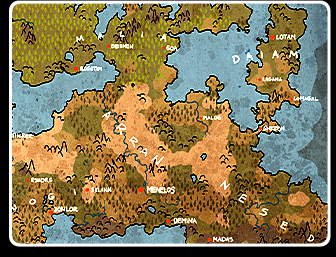
The third planet in the system, referred to by many of its inhabitants as Tirot ("ground, soil"), but more broadly as Deinar, is a temperate Earthlike world. Deinar's climate is cooler and more arid than Earth's, with a thinner atmosphere (an average pressure of 0.8 atm at sea level). It has large permanent polar icecaps that are static due to Deinar's minimal axial tilt and corresponding lack of seasonal variations in temperature. The day is 19.88 hours long and Deinar's orbital period is 350 Earth days. Most of Deinar's land mass is collected into a large Pangaea-like supercontinent called Mestirot, and there is a smaller Western continent that snakes south from the northern icecap across the equator to the southern hemisphere (called Norrid Taneis, the "Freezing Cape" by its inhabitants). The planet has only primitive native life, the most advanced being planktonic marine organisms. Terrestrial life forms consist almost exclusively of introduced organisms: the Loroi, various Soia-liron domestic species and their descendants.
Deinar has two small moons: the outer moon, Talas, is about one-fifth the mass of our Moon; the inner, Mepona, is much smaller and shepherds a faint ring, probably the result of a recent impact (within the last few million years). Because of the hazards posed to objects in low orbit by Mepona's ring, most satellites and orbital infrastructure must be placed in much higher orbits, or around the outer moon. This increases the cost of lifting mass into orbit, but for space-based manufacture this is partially compensated by the abundance and accessibility of comets and asteroids. Dawnspire Citadel, the Minzan sector fleet headquarters, orbits Talas, and the Deinar Fleet Yards orbits the Deinar-Talas Lagrange-1 point.
Biosphere
Within the somewhat narrow temperate zone, land outside the deserts is dominated by imported alien organisms: grasslands of the misesa supergrain, forests of evergreen nagen, and the smaller bizal and sibreg. Animal life consists almost exclusively of the radiated descendants of just two domesticated species, the miros and tirriti, Soia-liron analogues of the pig and chicken, which feed on the domestic crops (and occasionally on each other). Since the re-establishment of starflight and contact with other alien biospheres, a variety of invasive alien organisms have found niches in this spotty biome, but this is a recent development that is still ongoing.
Since the planet has had only a short history of native life, there are no deposits of fossil fuels to exploit. Mineral deposits are not highly concentrated or particularly rich. There are also no native disease organisms capable of infecting Loroi or other large animals, except for remnants of introduced terraforming yeasts (in the Dreiman and Soia eras) that can still cause minor respiratory infections.
The Deinar Loroi consist of three loosely-defined ethnic groups: the Barraid of the western forests and highlands, the Tadan of the central arid plains, and the Login of the northeastern coast and highlands. The fair-skinned Barraid are tall and athletic; the darker-skinned desert-dwelling Tadan are more slender and with a reputation for beauty and elegance, and the Login are widely distributed and are shorter and wiry, with a reputation for toughness. Although the Barraid and Tadan groups have had a long history of conflict, they share similar martial traditions. The Login cultures had early advances but became isolated and mostly retreated to the periphery of Mestirot and even crossed to the Western continent in the late pre-industrial era.
 Zaral
Zaral
The Loroi Imperial Capital, the city of Toridas, is located in the Barraid nation of Zaral on the west coast of Mestirot. The Western Loroi cultures existed for much of Deinar history in the shadow of Arran and the other central Tadan civilizations, but Zaral rose to prominence in the late industrial period and became a technological powerhouse. Zaral defeated Arran in the modern-era world war that unified all Deinar Loroi under one government and opened the way to space travel and the rediscovery of starflight. Zaral is now "first among equals" in a federated system along with the other former nations as territories in a government that manages the whole planet.
Government
Like most Loroi planetary government entities, Deinar is a military oligarchy run by a council of elders and a twin executive (consuls). Council delegates are sent from the various provinces (each appointed by local military leadership according to their own customs). One of the executives is elected from within the elder council, and the other is a governor appointed by the interstellar Imperial government. Since Toridas is also the seat of the Imperial government, the Imperial governor in this case is also the Loroi Azerein (currently Greywind). The Azerein is assisted by the Diadem, a council of the joint chiefs of the various military caste organizations, which advises her and has the sole authority to appoint or impeach the Azerein. The Azerein and her staff are frequently abroad dealing with imperial or foreign matters (including the current war), and at such times the elder council-elected consul is the most senior leadership figure.
Soroin Headquarters
The Soroin is the caste to which most Loroi warriors belong. It has administrative buildings and academies on many Loroi colony worlds, but its headquarters and prime academy are located in the fortress city of Adadis in Zaral. Adadis was a key location in the generations-long wars between Zaral and Enogi, and the modern city still retains sections of the old earthen walls and many period buildings. Although the Imperial government is run from nearby Toridas, the military bureaucracy has its most important offices in Adadis in the Agate Keep, a modern structure rebuilt in the style of a classical stone citadel. Warrior children training in Soroin dirals from this region are sent into the ruins of Nileser, an Enogi fortress that sat across the river from Adadis, to conduct mock battles and construct makeshift forts amongst the crumbled stone walls. The children carve names and slogans into the stone alongside those from a thousand years in the past.
Teidar Academy
The ancient Stone Watcher Citadel, which overlooks Toridas from the Redcliff Falls above the city, is home to the Teidar Academy, the chief training site for the main Loroi psionic warfare caste. In terms of logistics and administration, the Teidar act mostly as a subset of the Soroin caste, but the Teidar have a very distinct operating culture, especially in terms of training. While the Soroin have training facilities on nearly ever major colony, all Teidar trainees from across the empire are brought to this facility in Toridas.
Teidar dirals are kept strictly segregated from those of other castes, and are shrouded in ritual. Unusually for the normally cooperative Loroi dirals, the Teidar trainees are actively encouraged to engage in psionic duels with one other.
 Arran
Arran

The center of power and culture for most of Deinar history was in the great city of Menelos in the Tadan nation of Arran. Menelos was founded near the headwaters of the great Arran River that flows mostly through a desert plain, and which gives quick access to much of the central portion of the continent. Although Arran's technological advancement fell behind in the modern age and eventually submitted to Zaral after the Deinar world war, Menelos is still the cultural heart of Deinar and, to an extent, the entire Loroi empire. The grandeurs of its monumental architecture and lavish public galas still draw visitors from across the empire and beyond. Its vistas include its many spires and towers, and the colossal statues and elaborate cenotaphs erected to the honor figures of Loroi heroic legend, the most prominent dedicated to Salinn Bladestorm, the nation's founder.
Arran is still technically a territorial holding of Zaral, and answers to the government in Toridas, but in effect it is governed as its own principality. Arran is governed by a similar council of elders, though it is larger and more Byzantine in its complexities and procedures than most, as Arran still upholds many ancient traditions in its current government. Arran government is unusual on Deinar in that it includes a sort of "plebian council" of that gives a voice specifically to civilian females.
Sorron Daril Nedatan Quarter
Menelos is home to the current incarnation of the first Nedatan abbey, the "Golden Bough." Although the caste system with its male philosopher orders has its origins to the north in Malia, the Nedatan order reached its modern form here in Arran. The modern Nedatan complex occupies its own quarter of the city, encompassing the abbey, several institutes for study, and a variety of public demonstration halls. The complex is named for Goldleaf, a legendary male seer who was a principal figure in the foundation of the Nedatan order.
The ancient monastery is now an public attraction open to visitors (the male Nedatan residents currently housed in more comfortable modern lodgings), but the ancient Oracle Tower is still used by Nedatan Nilodi to meditate and tap into the telepathic emanations of the surrounding Loroi populace.
Malia
Deishen in Malia was one of the earliest permanent Loroi settlements to take hold at the end of the Reign of Chaos around 6,000 BCE. It is still an important cultural and commercial region, and Deishen is still the most populous Loroi city on Deinar. It was the site of the original Diadem, the stone circle at which the legendary Lawbringer would call the chiefs of the nomadic barbarian tribes to parley and trade, and to teach them the ways of Malia's new civilized society and caste system.
Taiozel Library
According to legend, the agricultural settlement of Deishen was destroyed six times by the surrounding barbarian tribes, but each time its hidden "library" was preserved, in the form of a group of male ninzadi (Listel-like "rememberers") who each time persuaded the raiders to leave them in place (or who escaped and returned to the site if taken away). These males formed the first philosopher order, the Taiozel, collecting and maintaining the telepathic heroic legends, deciphering the Soia text in the Mozeret ruins around them, and accumulating agricultural and technological advances, that allowed subsequent iterations of the settlement to begin again after the destruction of that wave of overpopulation had passed. At the seventh rebuilding of the city, when the Lawbinger successfully brought the clans to the Diadem, the Taiozel were ready with the knowledge that was needed to build a city.
Disciples of the Taiozel teachings would later go on to found the Nedatan order in Arran, but the Taiozel remains a distinct order into the present. Taiozel Ninzadi recount the heroic legends, but are also focused on historical and archaeological research, more so than the generalist Nedatan. The Taiozel were more influential in the west with the rise of Zaral and Somael, establishing a priority of knowledge and technology in subtle contrast to the focus on philosophy and mental disciplines in the Nedatan east.
Pipolsid Colony
There is a submarine Pipolsid colony in the bay near coastal city of Bogotim, southwest of Deishen, founded initially to study the Soia ruins on the ocean floor there. Bogotim hosts the busiest shuttleport on Deinar, making Malia a hub for commerce and the first point of entry for many foreign visitors. The Pipolsid colony is connected via tunnels to Bogotim to allow free access to the spaceport.
Daiam
Daiam is a long peninsula snaking north from the eastern coast of Mestirot. It was home to the largest and most prominent Login civilization of the ancient period, which once populated most of the east coast, but which retreated to the peninsula following the rise of Arran and Tadan culture. Although the Login were often viewed as a less-sophisticated culture by the nations of the West, the Daiam civilization founded permanent settlements that predate the foundation of Deishen in Malia, protecting the from the barbarian hordes with extremely high stone walls. A few examples of these ancient fortifications are still preserved in the modern cities, most notably the great wall at Shezen, built across the neck of the peninsula in the classical period to isolate Daiam from the encroaching Arran satellite nations.
Unlike the Western cultures, the Daiam Login did not adopt a caste system to control population growth. Instead, they developed practices of ritual culling of excess population -- viewed as savage even among the warrior cultures of the West -- to prevent depletion of resources during the peaks of the cycles of overpopulation and destruction. Although Daiam eventually became a vassal state of Arran and later Zaral, today it is still the primary holdout of Login culture against the pervasive influence of the Western Deinar culture that has spread across the empire. The inhabitants still maintain many of their traditional customs (though ritual sacrifice is not longer legal), including their own version of the male philosopher order, the Eitar.
Norrid Tanaeis
The Western continent is a slender landmass that snakes from the northern ice cap to just south of the equator. It is mountainous and very cold, even in its southern extents, due to ocean weather patterns that bring arctic air south along its length. This landmass appears to have been uninhabited during the Soia period, and only some species of nagen evergreens crew there in ancient times, the spores apparently carried there from Mestirot by winds. The continent was uninhabited by Loroi until the late pre-industrial period, when Login exiles made the treacherous ocean crossing to establish small settlements.
In the late industrial and early modern eras, Arran and Malia began to establish resource extraction colonies on the continent, sparking continuous conflicts with the Login natives. Zaral also inherited some colonial concerns as an unexpected by-product of several diplomatic agreements with other Mestirot nations. These conflicts gradually escalated into proxy wars between the colonial powers, in which modern mechanized warfare occurred for the first time, foreshadowing the world war on Mestirot which would follow soon afterward.
Today Norrid Tanaeis is still sparsely populated. It is governed as a confederation of independent city-states, nominally under the Zaral-led planetary government, but in practice largely isolationist and left to itself. The largest settlements are Koman in the northern highlands and Koshan near the equator.
History of the Colony
Archaeological evidence of the Loroi presence on Deinar dates back to the fall of the Soia Empire c.275,000 BCE, but the planet had already been inhabited by Soia-liron races for tens of thousands of years by that point. There is still some debate as to whether Loroi ancestors had lived on the surface of Deinar before the Fall, but if they did so they left no direct evidence.
Precursor Settlements
Alien colonization of Deinar dates back to nearly 1 million years before the present, when Dreiman terraforming organisms were introduced to the planet. Although Deinar III had native life in the oceans, the land was completely barren and the atmosphere still very thin. The Dreiman meredtar is a compound organism with properties similar to a lichen, the growth of which darkens the surface, breaks down rock and dust into useable soil, and liberates oxygen and CO2 into the atmosphere. Descendants of these organisms still exist on the planet today, including some airborne pathogens that can cause respiratory ailments among Loroi.
The first evidence of alien settlement dates much later, c.300,000 BCE, coincident with the introduction of the Soia-liron plants and animals that are characteristic of Soia colonies. The earliest known inhabited sites were near what is modern-day Bogotim in Malia, and over the next several thousand years, more semi-urban settlements radiated across the continent along with the spread of the forests. These urban sites contain ruins and some Soia-era artifacts, but no remains of the colonists themselves; it appears that they must have had funerary practices that efficiently disposed of urban waste, including the dead.
Some of the outlying rural sites, however, do preserve remains of two Soia-liron species that are thought to have been intelligent: the Mozeret and Tagid. Remains of the centaur-like Mozeret have been found in sites that appear to be ritual burial mounds, scattered across the countryside. Loroi legend makes veiled references to wardens or caretakers of planets, and this has led Loroi researchers to propose that the Mozeret supported terraforming efforts and perhaps managed livestock and perhaps farms. The grave goods found in these mounds include pastoral implements and a few remains of miros and larger Soia-liron livestock (now extinct on Deinar).
The squat, scaly Tagid have been found only a few sites underground, in what seem to have been mine collapses or other industrial accidents in which the bodies were not recovered. These remains are consistent with those found on other Soia-era colonies in that the Tagid appear to have been involved in resource extraction and heavy industry. Unlike the hints provided in the Mozeret burial mounds, Tagid culture remains a mystery.
However, the ruins and artifacts found in the urban sites suggest that the urban inhabitants were at least roughly humanoid, with tables and chairs, etc., that don't seem well suited to the Mozeret or Tagid physiques. The data on the found digital devices did not survive the bombardment and the intervening millennia, and the surviving physical inscriptions and texts in Trade are extremely mundane, essentially public signage and instruction booklets and the like. There are proper nouns thought to refer to local places or public figures, but no references to species.
Soia Fall and Arrival of Loroi
Whatever its purpose, the Soia-era civilziation on Deinar III came to an abrupt end with the c.275,000 BCE bombardment. At this time almost every known Soia-era settlement was subjected to intensive bombardment from orbit. On Deinar III, every technological settlement on the surface was destroyed, and many of the introduced Soia-liron plants and animals were wiped out. The nagen forests burned, and even those species that survived (such as the miros and tirriti) had their populations dramatically reduced. However, there are no verified remains of the colonists in the bombardment layer itself; the Mozeret and Tagid remains appear to be earlier, and the Loroi remains found in these sites appear to have arrived after the bombardment had ended.
These Loroi remains are the earliest found on Deinar. It is not known how or exactly when they arrived, and they appear to have died from starvation, exposure, or physical violence while scavenging in the ruins. Local legend holds that these Loroi were the survivors of a Soia "dread-star," a massive mobile space habitat, that either crashed or was abandoned in orbit. It seems clear from the state of these remains that the environmental catastrophe caused by the bombardment was still in full effect; this would have been a desperate environment to attempt to survive in.
A number of settlements have been found that were established in the period immediately following the catastrophe, and it seems from the structures and artifacts found at these sites that the Loroi refugees still at that time had access to their Soia-era technological tools and weapons. However, these settlements were wrecked and abandoned within a century after their founding. Signs point to attack by other Loroi refugees, desperate for supplies and equipment. It seems that any fixed settlement was a target for attack, and so the survivors became wandering bands, searching for food and supplies, and fighting off other bands when such supplies were found. Only Loroi remains have been found above the bombardment layer (cremated and buried but identified by bone fragments), no Mozeret or Tagid remains have been found. Mezan also appears to have been evacuated around the same time, but if any refugees subsequently landed there, no trace has been found.
Reign of Chaos
Deinar entered a long dark age in which nomadic barbarian hunter-gatherer tribes dominated the landscape. They had retained very little technological expertise, depending on scavenged artifacts for use as makeshift tools and weapons, and subsisted on plentiful food sources, hunting feral domestic animals and gathering fruit and wild grains. However, the long Loroi lifespan, short maturation cycle and larger percentage of childbearing females meant that population sizes grew rapidly, outstripping local food sources and necessitating constant conflict with neighboring tribes. This perpetual state of warfare meant very little reserve food or population specialization, meaning that the Loroi were unable to progress past the most basic technology and hunter-gatherer lifestyles. Inevitably, population sizes would grow the point of famine, during which any permanent settlement or storage of food would be plundered and destroyed by roving hordes of starving, desperate Loroi. After most had died from violence or hunger, the few survivors would reform loose bands and begin the cycle again, repeated over and over for millennia. The cycles of destruction became so regular that the Loroi tribes began to accept them as an inevitable feature of existence.
Lawbringer's Rule
Malia is probably the source for the exotic miros-girl legends, etc. Maybe that was even associated with Lawbringer.
Maybe their thing was the ability to coexist in dangerous parts of the forest with huge wild miros that had become carnivorous. They were probably like wolves in that they were either domesticated or eliminated.
After long ages of chaos, eventually few Loroi societies developed to a point where they could organize themselves well enough to survive the barbarian tides. The first of these was actually among the Login tribes in eastern Daiam around c.4500 BCE, who learned to build stone fortifications in which limited populations could survive the barbarian rampages. These were eventually able to control their own population growth to a sufficient degree that they could grow into the walled city-states for which Daiam became famous. However, the more influential and more widely celebrated example was the establishment of the city of Deishen in Malia in 4462 BCE, and the implementation of the Telabel Lanzaid, the now-ubiquitous warrior caste system. Restrictions were placed on reproduction while at the same time using access to mates as incentive to control the behavior of the formalized warrior class. Credited to the semi-mythical figure "Lawbringer" (Lanzatamadi), this system was probably not her invention, but she did play an important role in spreading it to the nearby tribes, forestalling overpopulation instead of defending directly against its results. Variants of this social order quickly spread to the south (Arran) and west (Deben), and Loroi society slowly crawled out of its dark age... even while barbarian tribes in the north and east would continue the old cycle of destruction for many centuries. The city-states of Malia became the great powers of this new civilized age.
Menelos and the Golden Age of Arran
The distinctive southern adaptation of the caste system was established in Salinn in 4177 BCE by Malian exiles. This society spread throughout the Tadan peoples of southern Arran, but would be dominated by the regional power of Malia for another thousand years before the gradual rise in power of the Arran city-state of Menelos. After breaking free of vassalage to greater powers, Menelos would eventually gain vassals of its own until it ruled over all of Arran and parts of the East.
Throughout the continent the lesser city-states became vassals of the greater ones, seeking protection of Menelos protection from it. By the second millennium BCE the power blocs had coalesced into networks of alliances comparable to modern Earth nations, excepting only the scattered Login tribes in the North and East. In this relatively stable environment, an era of comparative peace allowed Menelos' empire to prosper as none had ever before. The civilian class swelled in size and influence, and Menelos' wealth and resources were spent on great works of culture and science. Conflicts between Mestirot empires became ritualized, with armored legions still clashing with spear and sword well into the early industrial age, and Teidar officers singling each other out for personal duels to settle disputes in lieu of infantry battles.
Arran dominated in psionics, but Zaral and the west had started to outpace them in technology. This became decisive after the introduction of gunpower and industrial technology. Zaral and Enogi began to use fortifications.
Rise of the West
In the west of the continent, three Barraid nations quietly increased in technology and power. While still a backwater compared with the grandeur of Arran, the Barraid of Deben had mostly busied themselves with fighting each other. But in 790 BCE, at the height of Arran's age of peace, the nations of Zaral and Somail allied against their sworn enemy Enogi, and more than a thousand years of bloody wars followed, in which Zaral slowly and painfully gained ground against their nemesis. By the time Zaral's alliance trod upon the enemy's standards in the Enogi capital of Donlor in 611 CE, Zaral had surpassed Menelos in military power and technology. In the meantime Menelos had modernized and even conquered Malia to the north, and Arran culture was still second to none, but the aging empire was a sick old crone in comparison to the strength of the West.
in 730-835 CE There followed a series of proxy wars on the Western Continent between puppet regimes controlled either by Zaral or Arran. This followed the development of combustion engines, and was the testing ground for the first combat aircraft and armored vehicles. Zaral was even flying the first rockets. Zaral's proxies had gained command of most of the continent by 785, but sporadic conflicts continued until 835.
After the wars in the Western Continent, Arran had kind of become the "sick man" of Mestirot and was in decline; they were equivalent in technology to the West but it was not of the same quality in "men" or materiel. The value of pre-amplified Teidar was limited against modern weapons. However, Arran still had cultural power, especially in controlling the Nedatan and their influence within the international order. Arran-aligned Nedatan had sowed enough discord in the West that there were uprisings in conquered enogi territory and even in Somail and Zaral.
Meanwhile in Mestirot a more direct conflict had been brewing between Arran and Zaral. Zaral's space program had advanced enough to fly a manned mission to Mezan in 780 CE. There they found technologies including psionic amplifiers which would increase their technological lead even further. But at home, Arran's cultural and political power had not diminished. Even as Zaral researchers used their new amplifiers to detect the presence of sister Loroi colonies in other star systems, Arran and their allies had sown rebellion against Zaral's ruling [council] within their own nation. Instead of using her forces to put down the uprisings, ion 835 Zaral's leadership launched an invasion of Arran itself. In the lightning actions that followed, Arran's defenses were outmaneuvered, surrounded, and rapidly defeated. Although the last of Arran's vassals and the rebelling Zaral allies would not be brought to heel until 842 CE, Zaral ended as master of an empire that controlled the majority of Loroi on Deinar. The chairman of the Zaral council declared herself First Deinar Azerein Zaral Siilad, Seed of Zaral.
Reunification
The war against Arran had been so one-sided that Zaral had not even paused its space program, and by 850 CE they were ready to test the new jump drive to visit the nearby star Saramalir, at which amplified telepaths had detected signs of Loroi habitation. This turned out to be Perrein. A second splinter colony had also been detected at Nonnos (Taben), but this would take another 45 years and the establishment of intermediate bases in order to reach the more distant star.
The next century would occupy the efforts of all three sister worlds to work towards rediscovery and cooperation. Deinar greatly surpassed the other two sisters in most technological areas, but the Perrein Loroi had mastered telepathic techniques unknown on Deinar, and both worlds offered the fruits of true native biospheres in addition to Soia-Liron organisms that had not survived on Deinar. In 1079 a joint coalition explored further star systems and founded new colonies on Mezan, Moriet and Talas. However, telepaths had detected the presence of both the Delrias and the Neridi, and the decision was made to pause and delay contact until a unified defense could be established. The Loroi Axis Pact, establishing a formal alliance and a joint Axis Assembly, was signed in 1196.
Splinter Wars and Imperial System
Through the coming war agains the Delrias and subsequent tensions with the Mannadi, the three sisters had managed to cooperate as independent entities, but as tensions with the Mannadi grew, the limitations of the Axis system were become apparent. Taben in particular had significant disagreements with the Deinar government, and this eventually led to the dissolution of the Axis Asembly and ultimately a series of civil conflicts between the various Loroi factions. In 1402 CE the factions finally united under a centralized Imperial system, and Laiedas ("Loremark") was named First Loroi Azerein. Toridas in Zaral on Deinar was established as the Imperial Seat and headquarters of the imperial government.
 Deinar Culture
As the seat of Imperial government and the origin of the vast majority of Loroi population prior to subsequent colonization, the wider Loroi culture outside of the other two Sister Worlds is for the most part Deinar culture.
Cuisine
Since Deinar foods are based entirely on the same Soia-liron domesticated organisms that are available on nearly every Loroi colony world. Deinair cuisine is widely adopted across the empire and forms the basis for military rations.
Loroi typically eat once per day, and dining is very informal and meals are often grabbed on-the-job without utensils. Zaral cuisine (Western Deinar) is very popular aboard ship, with lots of on-the-go finger foods like dumplings and filled buns. The pozet is a piroshki-like misesa-bread bun typically stuffed with spiced miros meat and mashed bizal (a tuber). Fried dumplings are common snacks, filled with bizal or dried sibreg (the fruit Alex is holding on the Chapter 2 cover).
See also: Loroi, Loroi Timeline, System Defenses