Data File Updated: Thursday, September 03, 2026
Overview
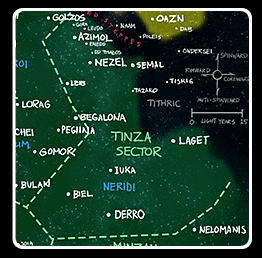
The diminutive Neridi are one of the three surviving intelligent races of the ancient Soia civilization which once dominated the Local Bubble. The Neridi were one of the first alien nations contacted by the Loroi after their rediscovery of starflight -- the Loroi discovered two Neridi splinter colonies in the Derro system, and helped them to rapidly regain access to starflight technologies. The Neridi have been the closest of Loroi allies ever since, and having cheerfully subordinated themselves to their Loroi benefactors, the Neridi have benefited more than any other Union member from operating under the Loroi shadow in supporting roles as merchants and administrators. The Neridi have settled numerous new colonies in the Tinza sector, which they administrate as a formal part of the Loroi empire (in addition to full Union membership), and share many installations with the Loroi. The Neridi have even standardized on Loroi Trade as the language of official business within their own borders.
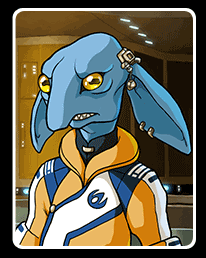 Neridi are
generally good-natured, gregarious, cooperative creatures, who prefer
negotiation to the use of force, and who reinforce social bonds and
resolve conflict with frequent intimate (and sometimes sexual) physical
contact. Neridi are known for their sense of humor,
though they do not laugh aloud like Loroi. Violence between them is not unknown, but it is the
exception rather than the rule. Even prior to the formation of
the Union and the centralization of the military, the Neridi
rarely had much defensive capability, relying heavily on their
allies, especially the Loroi, for support against Mannadi and
later Umiak aggression. The Tinza sector alongside the Seren
sector bore the worst of the Umiak assault in the early part of the
current war, losing several systems to the enemy and suffering
the oppression of Hierarchy occupation.
Neridi are
generally good-natured, gregarious, cooperative creatures, who prefer
negotiation to the use of force, and who reinforce social bonds and
resolve conflict with frequent intimate (and sometimes sexual) physical
contact. Neridi are known for their sense of humor,
though they do not laugh aloud like Loroi. Violence between them is not unknown, but it is the
exception rather than the rule. Even prior to the formation of
the Union and the centralization of the military, the Neridi
rarely had much defensive capability, relying heavily on their
allies, especially the Loroi, for support against Mannadi and
later Umiak aggression. The Tinza sector alongside the Seren
sector bore the worst of the Umiak assault in the early part of the
current war, losing several systems to the enemy and suffering
the oppression of Hierarchy occupation.
The Neridi are divided into four distinct sub-cultures, with their roots on Derro and which have extended in modified forms out to their colony worlds. Derro and the various Neridi colonial entities are amalgamated under a hereditary constitutional monarchy, with Derro as its capital. (See Society, below)
Biology
Neridi are small 80-100cm (2'8"-3'3") in height, blue-skinned bipedal creatures. They have large disc-like yellow eyes, elongated heads and large floppy ears. Their biochemical systems are based on the Soia-liron pattern, which is shared with the Loroi, Barsam, and all other surviving organisms of the fallen Soia civilization. This artificially-tailored biochemistry provides the Neridi with very efficient metabolisms, excellent environmental adaptability, low mutation rates and correspondingly long lives. With their smaller size and less strenuous lifestyle, Neridi can live longer even than their Loroi cousins, sometimes surpassing 500 years. Neridi are omnivorous, preferring fruit, seeds and nuts, supplemented by dagiis dairy products, grain and the occasional meat. They have robust incisors that can gnaw through tough seed husks, including that of the nagen.
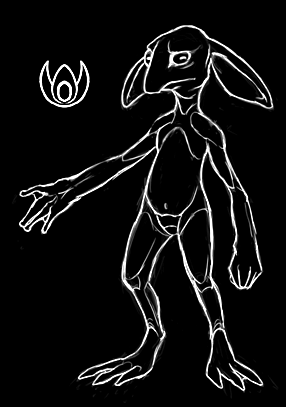 Neridi
have excellent hearing and smell, and superior low-light vision.
Neridi are notably pungent, with the interchange of various
pheromones playing an important role in social interactions.
They have large four-fingered hands and powerful forearms that
give them a strong grip -- it is theorized that their ancestors
may have been arboreal and perhaps nocturnal. They also have
vestigial webbing between the first and second, and third and
fourth fingers, and between the second and third toes. Neridi are not native to Derro, but
are presumed to have come from outside the Local Bubble along
with the other Soia-liron species. Ancient proto-Neridi remains
have been found in pre-Fall ruins on several other planets, but
the splinter colonies on Derro appear to be the only local
survivors of the catastrophe that ended Soia rule in the Local
Bubble. Like other Soia-liron species, the Neridi genome shows
clear signs of artificial manipulation, with a dearth of random
"junk" genes or mutation markers that precede the time of the
Fall.
Neridi
have excellent hearing and smell, and superior low-light vision.
Neridi are notably pungent, with the interchange of various
pheromones playing an important role in social interactions.
They have large four-fingered hands and powerful forearms that
give them a strong grip -- it is theorized that their ancestors
may have been arboreal and perhaps nocturnal. They also have
vestigial webbing between the first and second, and third and
fourth fingers, and between the second and third toes. Neridi are not native to Derro, but
are presumed to have come from outside the Local Bubble along
with the other Soia-liron species. Ancient proto-Neridi remains
have been found in pre-Fall ruins on several other planets, but
the splinter colonies on Derro appear to be the only local
survivors of the catastrophe that ended Soia rule in the Local
Bubble. Like other Soia-liron species, the Neridi genome shows
clear signs of artificial manipulation, with a dearth of random
"junk" genes or mutation markers that precede the time of the
Fall.
Sex and Gender
Neridi are hermaphroditic, with adult individuals having both male and female sexual apparatus, but the organs producing sex cells and the appropriate hormones can only operate in one mode or the other at a time, so each individual has an implicit male or female gender at any given moment. Neridi females give live birth to single offspring, and infants and juveniles do not exhibit any gendered sexual characteristics until they reach sexual maturity, at which time each individual develops a male or female identity. This is not a conscious choice, but an involuntary biological change. The changes are internal and hormonal -- males and females have the same external sexual apparatus, but the internal changes affect personality and behavior as well as the production of sex cells and pheromones. It may be difficult for non-Neridi to tell the difference between genders by sight, but Neridi can tell instantly by scent, as well as by distinctive behaviors.
Neridi have four distinct gender modes, two each male and female. Individuals switch between modes over their long lifespans, according to their age and certain environmental factors. Upon reaching maturity, the majority of Neridi first develop the sexual characteristics of a "bearer" or "fertile female." Fertile females are energetic, ambitious and territorial, often forming the center of any given social circle.
A minority of adolescents instead develop the characteristics of an "itinerant male" or "wanderer." These males are more creative and adventurous, and often develop wanderlust, leaving their family groups to visit foreign lands. Most matings that produce offspring are between fertile females and visiting foreign itinerant males, promoting healthy genetic diversity. These males will be accepted into a foreign family for a time, mating with the fertile female(s) and performing whatever services they are capable of (often artistic or performance-oriented professions), before the wanderlust overcomes him and he travels again to find another family.
Young females stay in the fertile "bearer" mode for only a limited time, typically around 50 years. When she reaches the appropriate age, and especially if there are other, younger adult females in the family group, she will eventually transition to an alternate male state, known as the "resident male" or "builder." Again, this transition is involuntary and not a conscious choice. The female becomes morose and lethargic, and by tradition she is usually isolated to await the transformation, sometimes with appropriate rituals. After a few days to a week of internal metamorphosis, she emerges from isolation as a resident male. Although the individual does not change much outwardly in appearance, he undergoes a significant change in personality. Resident males are more serious and industrious than their earlier female personas, and while they are sexually functional as males, they lack the impregnation drives of the itinerant males and usually accept a supporting rather than primary role in the family. The new male will often seek a new profession and may even change his name to reflect his altered status. The new male will spend most of his long life in this gender mode, and the majority of the Neridi population at any given moment are resident males.
Itinerant males remain fertile and in the same gender mode for much longer than fertile females, up to 100-150 years. Because of their adventurous lifestyle, itinerant males are more likely to meet premature death than other genders. If he survives to the appropriate age, he will eventually lose his wanderlust and undergo a transformation similar to the young females. After the period of isolation, he will emerge in the fourth gender form, the "retired male" or "sage." This mode is mostly sterile but technically female, since she exudes feminine pheromones and can become pregnant under certain unusual circumstances. The individual will most often settle permanently the current family, taking the role of an advisory elder, armed with the experience of many years of traveling abroad. Various Neridi professions maintain academies led primarily by retired males, and so a newly transformed retired male may seek or be invited to join one of these convent-like institutions.
Gender transition is highly dependent on environmental triggers in addition to age. Juveniles who are in a family that already has several fertile females may either experience delayed puberty, or else be more likely to develop as males. Transition of a fertile female to resident male will also be delayed if there are no other fertile females in the family, or accelerated if there are too many. In complete absence of fertile females, a resident male may transition back into a limited female state, or a retired male may become more fertile, though this is rare and can be very disruptive to that individual's physical and mental health. Transitions can also be triggered artificially through medical technology, though such transitions can have both medical and social complications.
Neridi use sex separately from reproduction as one of their primary social tools, using it to build social bonds and establish hierarchies, resolve conflicts, or just manage stress. They engage in frequent, diverse sexual behaviors without regard to age or gender, since males and females have the same external sexual apparatus. These behaviors can range from casual intimate petting or groping to full sexual copulation. Pregnancy is only possible with male and female pairings, and normally only when the female is aroused in a particular way, which normally only occurs between fertile females and itinerant males.
Neridi extended families typically consist of 10-20 individuals, mostly resident males, a few fertile females, one or two itinerant males, and possibly several retired males. Sexual activity between family members is the norm, with the fertile female(s) using her desirability to more or less control the family. While she will frequently copulate with male relatives, she will normally only become pregnant through mating with itinerant males, so inbreeding is not usually a problem.
Neridi sexual activity extends beyond the family into the workplace and social spaces, with casual sex being the norm in all manner of social interactions. As in the family, social groups tend to be dominated by the influence of ambitious fertile females. This model of female influence extends even to Neridi government, with fertile females as (mostly figurehead) monarchs in administrations run by resident males. There are conservative Neridi subcultures that restrict sex to the family unit or their own social class, but wider Neridi society is usually much more liberal in having sex with pretty much everyone.
 The
Neridi Viceregal Commonwealth
The
Neridi Viceregal Commonwealth

The Commonwealth is a voluntary association of Derro and its "Ring Colonies," the various worlds colonized by the Neridi since the rediscovery of starflight, ruled by the Derro Regent and her designated Viceroys. The Regent is not an absolute monarch, but rules as a largely ceremonial figurehead on behalf of the various governmental councils. The Regent is always female and follows a hereditary matrilineal succession. The symbol of office of the Regent is a large ring of pale metal, about six centimeters in diameter and of pale metal, a Dreiman artifact brought from Thabaki Stead by the early settlers. Because the female mode is only temporary for Neridi, the office of Regent changes frequently as female Regents transition to resident males, and "retire" to join one of the various councils, which are filled with former Regents.
The primary constitutional element of the monarchy is a sort of parliament, known as the Ring Council, which governs Derro and to a lesser extent the Commonwealth on behalf of the Regent. It is a single body with multiple committees, including aristocratic titles, elected and appointed officials. Although some of the Council members are elected, the Council is the apex of an extensive bureaucracy, run mostly by appointed resident males, who exert most of the government's authority. However, despite its cumbersome size, the bureaucracy prefers to stay out of the way of private Neridi commercial concerns -- especially if the right palms get greased. Neridi democracy is kept at a minimum. Since joining the Union, the Ring administration no longer controls a formal military (it is now a police and patrol force), but it still manages much of the Tinza sector administration and important border defense installations in conjunction with the Loroi military.
Though most councilors and bureaucrats are resident males and therefore nominally devoid of ambition, they were once ambitious females and sometimes of high aristocratic office, including some former Regents. So they are not always as supportive and free from personal agenda as their gender role dictates.
Individual colony worlds beyond Derro are nominally independent sovereign nations with individual Union status, federated as a commonwealth and each allocated a Derro Viceroy to represent the Ring's interests. Viceroys are technically figureheads similar to the Regent, lending legitimacy to whatever the local nation's form of government is. Most colonies mirror Derro's consular government, though this is not a requirement. Viceroys are drawn from high aristocratic families and sometimes even the royal family itself, so the degree to which they are figureheads also varies. There are also a few independent Neridi colonies that operate outside the Commonwealth system, but still within the broader Union framework.
Derro
Derro is a small terrestrial world of about one-quarter Earth mass that is tidelocked to its large moon Arathemi, giving it a day-night cycle of roughly 9 Earth hours. It is temperate and wet with large oceans and a dense atmosphere of 1.5 atm, which together with its low surface gravity of 0.6 g helps to mitigate the stronger Coriolis forces of its rapid rotation, providing a very stable (if rainy) climate with very little temperature variation across the entire globe or even during the short night. Near-constant global cloud cover further evens out temperature variations, reflecting excess sunlight during the day and trapping heat at night.
 The
fixed tidal deformation caused by the tidelocked moon divides
Derro roughly into three large landmasses separated by
meridional
ocean bands. The Nearside and Farside continents are the tidal
bulges facing toward and away from the moon, dominated by
volcanic highlands and massive dormant shield volcanoes. Between
them, the tidal low region has forced up massive bands of
north-south mountains that circle the meridian perpendicular to
both the tidal axis and the equator, with ranges rising in the
low gravity nearly twice the height of the Himalayas. These
enormous mountains effectively separate the two hemispheres,
blocking east-west jet streams and dumping torrential monsoon
rains on the foothills. Parallel bands of seas run north-south
on both sides of the mountains.
The
fixed tidal deformation caused by the tidelocked moon divides
Derro roughly into three large landmasses separated by
meridional
ocean bands. The Nearside and Farside continents are the tidal
bulges facing toward and away from the moon, dominated by
volcanic highlands and massive dormant shield volcanoes. Between
them, the tidal low region has forced up massive bands of
north-south mountains that circle the meridian perpendicular to
both the tidal axis and the equator, with ranges rising in the
low gravity nearly twice the height of the Himalayas. These
enormous mountains effectively separate the two hemispheres,
blocking east-west jet streams and dumping torrential monsoon
rains on the foothills. Parallel bands of seas run north-south
on both sides of the mountains.
The Neridi capital city of Dirred Leste, the "Great Lighthouse," sits along a massive estuary where the great rivers draining the Nearside volcanic highlands empty into the meridional Nearside sea, looking up at the ever-present moon. It is by a wide margin the largest city on Derro, forming a trade and manufacturing hub for the entire Nearside continent, and the ancestral seat of the Neridi Regency.
Derro’s native biosphere is perhaps the most advanced among the Soia-era colonies: a low-gravity, hyper-oxygenated analogue of Earth’s Carboniferous biota, dominated by towering swamp forests and gigantiform life. Massive, spore-bearing flora -- 50-meter leafless columnar trees, hyper-reactive fernlike fronds, and sprawling gravity-defying segmented bamboo-like goliaths -- form dense canopies that pump oxygen into the thick atmosphere. These forests support colossal arthropoids, including 2–3 meter wingspan aerial predators, 4-meter-long multi-legged armored herbivores, and small leaping arachnid-like hunters that vault along the canopy. Because the dense atmosphere and low gravity mitigate many of the disadvantages of exoskeletons, arthropoid land dominance has kept would-be amphibian vertebrates in the water. In the shallow seas, muscular sea-lilies flex against brutal tidal currents, and brachiopoid colonies build towering reef spires. Low gravity enables extreme verticality and lightweight structures throughout, while the rapid rotation drives dynamic weather and extreme tides that shape both terrestrial and marine adaptations.
The most celebrated native Derro life form is the noillir fungoid that grows on the columnar trees, which is brewed into a potent tea, prized by Loroi and Neridi alike as a soothing if acerbic beverage.
Although Derro was not a colony under the Soia, the Neridi refugees evidently did bring domestic organisms with them. They have not fully displaced native live to the degree that they have on other worlds with more primitive life, but they are still important in the controlled environment of Neridi farms. Fields of misesa have taken over the formerly barren volcanic highland plains, and the goat-like dagiis (not native or Soia-liron but of unknown origin) provides meat and milk for distinctively smelly cheese.
Arathemi
Derro's tidelocked moon, named for the Matriarch-of-All in their mythology, hangs motionless in the sky above the Nearside continent. It is roughly the same mass as Europa but smaller and denser, with a pockmarked Io-like surface, scarred by widespread volcanism caused by the tidal stresses of the tidelocking process. Now settled into rotational synchrony with its orbit around Derro, the stresses have eased and the volcanoes gone dormant, but the surface is still covered in volcanic plains, rift zones and calderas, rich in heavy elements and sulfur compounds. The Neridi exploit this mineral wealth with large-scale mining operations and refining and manufacturing centers that feed the orbital construction infrastructure at Thabaki Stead and Bastoba Strand.
Thabaki Stead and the Great Ring
At the L-5 Lagrange point trailing Arathemi, there is a large and ancient O'Neill-style cylindrical space habitat. It has been here since the Dreiman era, and has been inhabited by Neridi ever since refugees arrived shortly after the Soia Fall. Successive generations of Neridi from Thabaki Stead left aboard makeshift shuttles to colonize Derro, but each expedition further stripped the station of resources and equipment. By the time Loroi scouts investigated the system around 1200 CE, what should have been a self-sustaining space habitat had been gradually reduced to a refugee camp scraping to survive. Today the Stead forms the hub of Derro's extensive orbital manufacturing complex, fed primarily by mining and factory installations on airless Arathemi.
The cylinder's rotation gives the inner surface an induced gravity similar to that on the surface of Derro. Thabaki Stead was one of at least two large space stations that the Dreiman had in the system; the other, most likely located at the L-1 point midway between Derro and Arathemi, broke up some time between the end of Dreiman presence and the Soia Fall, though it is not known exactly when or whether it was actively destroyed or merely broke up due to orbital stresses after having been abandoned. Debris from this ancient breakup still orbits Derro in diffuse ring fragments at 2:1 and 3:2 orbital resonances with Arathemi. Under the right lighting conditions they can be faintly seen from the surface and are called "The Great Ring" by the Neridi. New station and shipyard facilities (collectively known as the Bastoba Strand) have been constructed at the L-1 point to serve Derro's extensive shipbuilding and Union-wide shipping and trade network.
These ancient edifices represent another puzzling example of Dreiman engineering, focused exclusively on terraforming projects and spaceborne infrastructure, without any trace of direct habitation on Derro itself. What the Dreiman were doing here and why remains a mystery, further compounded by the apparent lack of any Soia-era habitation, despite Derro's favorable habitability.
Biel
Biel is a terrestrial world of about half Earth's mass in close orbit about a K-class orange star. It has a moderately advanced native biome and a dense, wet atmosphere. It was the first alien world colonized by the Neridi after their return to starflight, but it supports only a small Neridi population due to high levels of carbon dioxide. The majority of planetside residents are those researching or working to exploit the vast alien biosphere, but since the star system is along important transit routes between the Tinza, Maiad and Mannad sectors, the majority of the system's population live and work in orbital habitats. It was this strategic importance that made the system a flashpoint during early tensions with the expansionist Mannadi. Biel is still a major Tinza-Maia trade hub.
Biel has small seas and is hot and wet. Its dense atmosphere has a thick aerosol haze and comparatively high levels of oxygen, carbon dioxide and water vapor. This is an ideal environment for the red-pigmented terrestrial plant life and blue-green-pigmented marine algae which give the planet its distinctive dark red and blue-green colors, but the high CO₂ and acidic seas have deterred the development of multicellular animal life. So while there are advanced plants and trees analogous in complexity to Earth's early angiosperms, there are almost no complex native animal forms.
There is no sign of significant Soia-era settlements on Biel; this may have to do with its lack of habitability for Soia-liron colony organisms. While Dreiman and Soia terraforming biota can prepare a high-CO₂ world for habitation, there were evidently not designed to compete with existing complex native life. Neridi are comparatively tolerant to high CO₂ concentrations, and so can handle short unprotected outdoor exposures, but habitats must maintain active filtering systems to avoid long-term blood acidosis and congestion from the omnipresent aerosols produced by the vegetation. Neridi must wear filter masks to work outdoors for long periods.
There are remains of a post-fall Neridi settlement on Biel, possibly from the same group of refugees that colonized Derro, but it appears that they survived no more than a few generations, likely a casualty of the difficult conditions on the planet.
Nezel
Nezel is a purely terraformed world, with only imported Dreiman and Soia-Liron species, and remnants of a Soia-era Mozeret colony similar to Deinar. But it’s less habitable, cold and wet, with a lot of surface water, much of it frozen, and habitable coastline regions. Prior to being thawed by Dreiman and later Soia terraforming, the surface was completely frozen and lacking volcanism and a strong magnetic field, and so completely devoid of life.
Sometimes called "The New Capital," Nezel was second only to Derro in population and importance prior to its partial evacuation earlier in the war when it served as part of the defensive Golim-Tinza line, where the Hierarchy advance was eventually halted, and served as one of the jumping-off points for the Semoset counteroffensive. Today it is the Tinza sector reserve fleet base, and while it is under the jurisdiction of a Neridi Viceroy, the system is jointly occupied by both Loroi and Neridi forces and administrators. Though the main station at Liporen Harborage bears the distinctive blue and white fluted structures of Neridi architecture, it is armed with Loroi weapons and staffed by Loroi personnel.
 Azimol
Azimol is a smallish arid world with ruins of a vast planetwide Fenrias megacity. It has a small axial tilt and 4 moons, 2 of which are fairly large. It is relatively cold, with large polar ice caps, and relatively small seas. The equatorial region is overrun by a massive cold desert, which has buried most of the megacity ruins. There are small seas in rift valleys in the temperate latitudes, around which dark vegetation grows. The rest is a Mars rust color, with some darker colors where there is moisture and exposed rock. It has massive dust storms and is frequently covered in a haze of dust.
Azimol was a Neridi colony before the war, and was occupied by the Morat after being captured by the Umiak as they drove into the Tinza sector. Most of the population was able to evacuate before it was captured, but those left behind suffered cruelly under occupation. In some ways, the Morat were far crueler than the Umiak in occupation, but they were less dedicated to outright extermination. Even so, the Neridi have a burning hatred for the Morat. Azimol was liberated during the Semoset Offensive and has since been mostly a Loroi military outpost. It is one of the primary bases for Loroi interdiction groups operating in the Steppes from Tinza. Before the war it was primarily a research colony investigating the ancient ruins, but since its recapture most of its inhabitants are engaged in defense and supporting industries.
Azimol Citadel is the most extensive battle station network in the Tinza Sector. This is the main Loroi base for active fleet elements in Tinza, particularly for the raider fleets. Azimol is SG51's home port.
The majority of the ruins are very ancient, from before the Soia period, stretching back to the earliest starfaring civilization of the Local Bubble, the Fenrias (ancestors of the Morat and Delrias). There was probably a small Soia colony here, but it was localized and pretty well wiped out by the bombardment at the end of the Soia era. The flora and any fauna are mostly Fenrias transplants. There may be some primitive native flora. There may have been some Soia-liron livestock or flora, but they were limited to the colony areas and were mostly exterminated. The planet being a Fenrias archaeological site added an extra dimension of interest to the Morat occupation, and may have been a factor in why they refused the order to glass it when retreating.
Semal
Semal anchors the rimward end of the Steppes border, and together with Nezel held the Tinza line through the darkest days of the early war from 2139-2144 until the Semoset counter-offensive. Accordingly, it has a significant fleet base and substantial Loroi presence.
Laget
A joint Neridi-Loroi colony which bore the brunt of Umiak raids during the Tithric crisis from 2139-2141. Laget at the time lacked major defensive installations due to the presence of the then-neutral Tithric on the border, and so it was particularly vulnerable to assaults by Umiak fleets that the Tithric had allowed through their territory. There were points at which crasher forces had penetrated past the system and were threatening Derro and Nelomanis. Greywind sent an expedition under Admiral Sunfall that was able to stop the advance, and the pressure was relieved in 2141 when Sunfall razed the Tithric home planets.
Society
Neridi are group-oriented and can be intensely tribal. A common Loroi joke is that it takes a squad of Neridi to do anything useful.
Many Neridi are compulsive gamblers. Highly sybaritic and obsessed with fine food and ostentatious display of wealth. Status in the urban society is determined by a combination of lineage and wealth. The Neridi are obsessed with good-luck talismans and gambling. “Pungency is a key factor in determining an object's luck.”
Neridi architecture is noted for fancy fluted spires. The official colors of the Regency are blue and white.
Subcultures
All Neridi have ancestry that goes back to residence on Thabaki Stead, but their descendants have organized in four broad groups: the early settlers on Derro who quickly lost high technology and became the current Farmer class, more recent Thabaki migrants who retained more technology who formed the Urban class (which includes the aristocracy and the royal family), a group that broke off from the urban class to live in the central mountains who became the Caravanner class of traders, and a fourth group (Steaders) who were still living on Thabaki Stead when the Loroi arrived. Each group has various subgroups and in some cases, clans and elaborate family lineage distinctions. These basic groups have extended out to colonial worlds as well, with additional specializations and sub-groups.
The Farmers live the simplest existence, sometimes in traditionalist groups without high technology. Harvesting misesa and other high-yield crops from the well-watered soil is steady but easy work, and they live a very low-impact existence with little care for the outside world. Farmers tend to keep to the plains of the domed volcanic highlands and its river valleys, Mostly living in extended family groups or small towns. Nearside hemisphere farmers are mostly subject to the rules and government of the capital or its subsidiaries, frequently trading with the urban class. Farside hemisphere farmers tend to be more isolated, organized into their own small communes or entirely independent of state rule. Small groups of Farmers sometimes set up on colony worlds, usually to put even more distance between urban culture and themselves.
The Urban class is the largest and most diverse group, encompassing urban workers of all types, maritime traders, industrial farmers, the commercial and business class, and the aristocracy and royal family.
The Caravanners live in the higher altitudes of the central mountainous region. A sedentary subgroup lives in the foothills in coastal settlements or farming the rich monsoon-fed foothills, but the more famous group lives at higher altitudes, running trade caravans through the high mountain gorges. These caravans were traditionally the primary mode of contact between the two hemispheres; their importance as caravan traders has diminished with the arrival of advanced transport technologies, but their tougher mindset has found its way to the colonies and as workers in interstellar shipping.
The fourth group is the Steaders, some of whom still live aboard Thabaki Stead or in other orbital facilities throughout Neridi territory. The most culturally removed from the other groups, they were a wildcard in the development of the new interstellar Neridi society; on the one hand, they were highly technically capable, but on the other, they had been scavengers scraping by to survive, with practices and moral codes considered questionable (at best) by other segments of Neridi society. In the modern Union, Steaders have formed a sort of Neridi counterculture, highly technologically proficient, but with a reputation for theft, grift, poor work ethic and general lawlessness.
Language and Names
Despite Loroi Trade standardization, many Neridi personal and especially location names include artifacts of the various local dialects. Most notable are occasional uses of the hard "K" in place of "G," or "TH" in place of "S" (as in "Thabaki"). These are usually written in standard Trade characters but pronounced differently. Neridi personal names have elaborate multi-part elements which may change over an individual's long lifespan (see Society below).
Although the various Neridi subcultures have different naming traditions, personal names have mostly coalesced into a standard extended framework: honorific, title, family/clan, personal name, epithet. Example: "Madam Warrant-Officer Rinn Tenten Coal-Orb". Tenten is a commoner, but an aristocrat would have a second element to the family name (gens + cognomen). "madam" is an honorific used for retired males.
Both the urban Derro and Steader cultures derive from the same ancestral family/gens system. The caravanners have a clan system, but which fits into the same naming framework. Farmers traditionally had much simpler names, but most now conform to the urban standard.
Personal names are not gender-specific (note: Trade does not have gendered pronouns), but there is an element of the full extended name that includes a gender-specific honorific (analogous to Mister, Miss, Madam, etc.) that precedes a title. They sometimes (but not always) change their names after changing genders because their personalities changed, and the new name represents a new persona.
History: Origins and Pre-Starflight
The initial origin of the Neridi is unknown; if they had a template species, it has not been found and is presumably well outside the Local Bubble. There is no known major pre-Fall Neridi settlement, and so it is supposed that the proto-Neridi lived mainly in ships and orbital facilities similar to the proto-Loroi, but unlike the Loroi there are a variety of hints of their planetside presence in the archaeological record on several worlds.
Archaeological evidence of modern Neridi habitation begins with the two post-Fall splinter colonies on Biel and Derro. The Biel colony failed shortly after its foundation and the planetside settlements on Derro quickly regressed to dispersed farming communities. The inhabitants of Thabaki Stead, the ancient space habitat in Derro orbit, retained higher technology levels but suffered from lack of resources. Successive waves of migration from Thabaki to the surface exacerbated this situation, as they depleted station resources further and usually lost contact shortly after planetfall. Those Thabaki Steaders that successfully migrated to Derro took over the planet, establishing the capital city and the ruling class and monarchy that persists to the present day. They founded Dirred Leste, the "Great Lighthouse"), the capital city of Derro and the ancestral seat of the Neridi Regency. It is a port city and trade hub, settled by migrants from Thabaki Stead. With significant technology enough to build a great city, they awed the "native" Neridi patch-farmers, herders and caravaneers who accepted them as a new aristocracy.
When Loroi scouts arrived at Derro (by choice, already knowing they were there, about the same time as they contacted the Delrias), the Neridi were quite technologically sophisticated, though they had not even started jump drive development. Unlike the suspicious Delrias, the Neridi were very friendly with the Loroi, and they quickly developed trade and technology exchanges. The Loroi taught the Neridi jump drive techniques, and the Neridi shared some of their advanced bio/food/hydroponics techs.
History: Starflight to Present
After the start of the Delrias War, the Neridi formally allied with the Loroi (even though they were too far away from the fighting for this to be much more than symbolic).
Following the conclusion of the Delrias War, tensions grew with the Mannadi, as new colonies from both nations began to encroach on each other. Mannadi privateers may have interfered with Neridi exploration missions, and may have raided as far into Neridi territory as Biel. This eventually escalated into a full scale war, which dragged the Loroi in. After this, it was largely a Loroi-Mannadi affair that stretched on for decades. At the conclusion of the war and the formation of the Loroi Union in 1557, the Neridi joined as charter members.
Prior to formation of the Union, the Neridi relied mainly mechanized security forces, due to Neridi unsuitability as ground troops. These were famously unsuccessful in their clashes with Mannadi forces.
Neridi Succession War
This succession dispute for the Neridi Regency was the trigger for a Loroi civil war between Azerein Swiftsure and Seren governor Eighth Dawn between 1790-1795 CE. The unexpected early retirement of the reigning Regent led to a succession dispute between a colonial viceroy of the royal family and a Derro-based claimant who was underage. It became a hot conflict mainly because the Loroi were involved; the Neridi factions became more aggressive because they knew they each had Loroi backing, and it escalated from there. Eighth Dawn backed the viceregal claimant and Swiftsure backed the Derro claimant.
The dispute began as aggressive posturing by the rival Neridi factions, likely never intending to resort to actual force, but the internal divisions among the Loroi had reached a flashpoint. Swiftsure's decentralized government had left a power vacuum, filled by the ambitions of sector governors like Seren's Eighth Dawn. By 1790 it had reached the point where Seren was conducting its own foreign policy with the newly-met neighbors in the Steppes, and Neridi colonial policy had become a matter of urgent concern for the Seren sector. Eighth Dawn backed a colonial viceroy with whom she had a good working relationship, and would not tolerate the accession of an underage puppet. The "war" ran hot and cold over five years, consisting mainly of staring contests in which a larger fleet cowed a smaller one into retreat, but there were several actual battles. The bloodiest was the decisive battle at Begalona in 1794, in which the Imperial faction showed up with a larger force, but a portion of it defected to the provincial faction during the battle, and the remainder surrendered after short but vicious fighting. After this, support for Swiftsure collapsed, and she abdicated in 1795 to be replaced by Third Emperor Eighth Dawn.
For their part, the Neridi were baffled that their political dispute had blown up in this way. The Seren-backed viceroy took the Regency, but in a twist characteristic of Neridi irony, the new Regent transitioned and retired only a few years later, to be succeeded by her underage opponent. However, the former viceroy's faction remained in control of the government, the young Regent being only a figurehead.
Hierarchy Invasion
Umiak forces overran the spinward frontier Neridi systems relatively early in the war, including Azimol, Nezel and Semal. After the fall of Seren, Begalona and Laget became the anchors of the Tinza line.
Most of the captured Neridi systems were made a part of Morat territory, and so were under a joint Umiak-Morat occupation. The largest captured Neridi colony was Azimol, which had a significant Loroi population. Loroi proved to be very effective insurgents. The Neridi were by no means innocent bystanders (a Neridi civilian can commit sabotage as well as anyone else), and it was a messy situation; when a facility blows up, you don't necessarily know who did it. The occupation forces were perplexed by the ability of captured populations to wage an effective insurgency even after they were rounded up and monitored. At one point the Morat began to suspect that the Neridi were also secretly telepathic. And unlike the comparatively dispassionate Umiak, the Morat (who were under a lot of pressure) responded with emotional harshness to the insurgency. To make a long (and unpleasant) story short, when the decision was made that the captured colonies could not efficiently be pacified, the resulting liquidation included Neridi as well as Loroi.
The Neridi have skin in this game. In addition to the losses during invasion and occupation, when the Umiak started raiding Laget through Tithric territory, it was mainly Neridi civilians who were killed. For the Neridi, the war is personal, and not just against the Loroi. In particular, the Neridi have developed a burning hatred for the Morat, who they had previously regarded as friendly neighbors.
See also: Races of the Loroi Union and Allies, Precursor Empires