Data File Updated: Thursday, September 24, 2026
Warning: this is an incomplete work-progress entry that is currently just a cleaned-up pastiche of notes and forum posts, presented here for reference. Please pardon the mess.
Overview
The Delrias and Morat are two current sentient species descended from the Fenrias, an ancient civilization with roots stretching back long before the arrival of the Soia or Dreiman. Today, the two cousin species are separated by significant physical distance and find themselves in opposite camps of the current Loroi-Umiak war, and the vast empire of their ancestors is remembered only in its scattered ruins and the diaspora biota that they spread across their former territory.
 Fenrias
The Fenrias were the first native star-faring civilization of the Local Bubble, and the only one (until Humanity) to develop jump drive without outside influence. At its height, more than a million years ago, the various extents of the Fenrias empire covered most of what is now Union and Hierarchy territory, though it was seldom under a single unified state.
The Fenrias stood more than 2 meters tall, powerfully-built but elegant and graceful. Two large wide-set eyes give binocular vision but also substantial peripheral vision, and four large ears provide them superb spatial awareness of sound. Luxurious furred coats in a variety of colors and patterns were a point of vanity for them, kept meticulously groomed and sometimes ornamented. Though sophisticated and cultured, Fenrias society was also aggressive and belligerent in the extreme, with personal duels and scenes of extreme brutality a commonplace experience. Fenrias could consume a varied diet, but many sub-cultures took particular interest in eating meat in exotic and sometimes brutal ways.
Origins - Kabel
The Fenrias evolved on Kabel, a planet in the Loroi Minzan sector, currently occupied by modern Delrias. At the time of their development, Kabel was a lush and verdant world teeming with diverse -- and dangerous -- life.
G star. Maybe somewhat like a Gaia world, become somewhat
hostile after having been abandoned and overgrown.
Maybe it had become so hostile that the Delrias didn’t consider
that it might be their homeworld? Perhaps mostly wasteland. It
might have been bombarded on multiple occasions, really working
the native ecosystems over… and then partially repopulated with
expat Kabel organisms, only to be hit again.
The Kabel (Fenrias) analogue to the cow would probably be milked
for the enriched blood, which is probably pretty gross to non-Fenrias.
The Fenrias homeworld of Kabel, which is part of modern Delrias
territory, had been obliterated in pre-Soia times by weapons of
mass destruction at the hand of other Fenrias factions. The long
history of Fenrias internecine warfare is mostly unknown, but
certainly involved the extinction of numerous offshoot species
and cultures. So ancient was the destruction of Kabel that in
the era in which the Delrias fought the Loroi, their capital was
Rubat, in a nearby system. Kabel, now a recovering but still
marginal world, was not even recognized to be the home system of
the Fenrias until after the Loroi-Delrias war.
Kaias
Hostile native organisms. Maybe fairly sophisticated ones akin to Gaiads or Scavengers. Maybe survivors of Fenrias Neandertal equivalents? That would be funny… though unlikely. More likely a development of Fenrias chimps or baboons.
Empire and Decline
Early Divergence: Because of constant factional warfare and
isolation (different colony worlds, splinter polities, resource
rivalries), genetic/cultural drift began while the empire was
still intact. Some factions may have already been on the path to
subspeciation or full speciation before the Dreiman arrived. The
empire was more of a loose network of rival states than a
unified whole.
Many Branches, Few Survivors: There were likely dozens of
Fenrias-derived populations or nascent species across their
settled worlds. Most went extinct during the Dreiman conquests,
the subsequent chaos, the Soia era, or the long dark age
afterward. Delrias and Morat represent two successful (or lucky)
surviving lineages that adapted to their respective
post-imperial environments.
Diaspora Tie-In: The Fenrias deliberately transplanted domestic
species, crops, and livestock from Kabel (and perhaps other core
worlds) to terraform or support their colonies. This created "Fenrias-seeded
biospheres" that supported their diverging populations. Over
time, some colonies may have further modified these ecosystems
(or themselves) to suit local conditions.
At the time that they expanded out into the stars, none of the other local species were near to having high technology, and so the Fenrias colonized much of the local region unopposed. Whatever entities had been contesting the region in the Bulan era had either collapsed or had given up interest, as there is no evidence that they interfered with Fenrias expansion. The primitive ancestors of today's intelligent species were either ignored or subjugated at the whim of local Fenrias rulers.
Though there was no external opposition to the Fenrias, it seems clear that they frequently warred amongst themselves and split into multiple competing empires. There was significant cultural and even biological drift between the Fenrias inhabiting different regions over the millennia, so it seems likely that the empire fragmented into multiple factions fairly early in their history. Several of these factions went extinct during this era, almost certainly as the result of inter-faction conflict; Kabel itself was depopulated by what appears to have been an orbital bombardment.
Fenrias Diaspora
A.K.A Kabelian clade, or Kabel Seed
The introduced Soia-liron species were invasive and out-competed many native organsisms where such existed in the same niche, but the number of introduced species was finite and they were mostly introduced on terraformed worlds with relatively little advanced native life. This contrasts with the pre-Dreiman colonization efforts of the Fenrias, who introduced gene-tailored versions of organisms from Kabel: these did come with all kinds of unintentional hitchikers and symbionts that typically wrought ecological catastrophe on native ecosystems, where present.
•
Boja
• Fenrias shrimp • I was eating some walnut shrimp today musing about how shrimp seem (on the back end at least) to be remarkably well engineered for consumption (shell, de-vein, presto), when I thought that a similar creature would be an ideal engineered food source. I think the Fenrias, who prefer meat to veggies (and probably don’t mind eating thing live -- or maybe that’s the Nissek) would be a good candidate to engineer one of their shrimp-like organisms into a super-shrimp, which is essentially a walking food item. It can eat pretty much anything (including sewage and garbage) and turn it very efficiently into efficient meat. • Let’s call this super-shrimp the Boja.
Boja could be found on pretty much any former colony world inhabited by the Fenrias, and that includes Moro. Because many of the former Fenrias worlds suffered multiple ecological catastrophes, Moro may be one of the only planets with large native boja populations. While I don’t think the Pipolsid are formidable predators, even if they’re filter feeders it’s most likely that they can eat meat. Barsam are omnivorous, so this will also be a popular food item for them. And of course for the wider Union.
Boja: an engineered shrimp-like creature. •The meat-loving Fenrias engineered one of their Kabel native shrimp-like organisms into a super-shrimp, which is essentially a walking food staple. It can eat pretty much anything (including algae, sewage and garbage) and turn it very efficiently into efficient meat. They probably grow to the size of lobsters if they have enough food. Boja can be found on pretty much any former colony world inhabited by the Fenrias, and that includes Moro. Because many of the former Fenrias worlds suffered multiple ecological catastrophes, Moro may be one of the only planets with large native boja populations. While I don’t think the Pipolsid are formidable predators, even if they’re filter feeders it’s most likely that they can eat meat. Barsam are omnivorous, so this will also be a popular food item for them. And of course for the wider Union. Boja may be a hit or miss item for Loroi (actually not all that unlike shrimp for humans).
Mizes
: (olive) – a deciduous tree with a small oily fruit. Probably wiped out on Deinar, possibly still growing in Amenal on Taben. (maybe this is an alien plant from elsewhere in the Union rather than Soia-liron. Maybe it’s a Fenrias staple, and useful even to the Delrias for oil.
Leror
(soybean): yellow legume. I think this could be Kabel organism, but it may also be found on Soia worlds. Maybe it's used only in processed foods as a protein substitute by the carnivorous Delrias.
Renzar
(corn): A fruit-bearing plant that produces red corn-like kernel. Maybe this is some kind of native plant. Perhaps a Kabel organism. The carnivorous Delrias may have little use for it, but the Fenrias might have.
(Cow)
(cow) The Kabel (Fenrias) analogue to the cow would probably be milked for the enriched blood, which is probably pretty gross to non-Fenrias.
(Pets)
-- there must be some animals in the Fenrias/Delrias/Morat diaspora that fit the niche of snuggly pet, and maybe even monkey-like mini-Fenrias. Sort of like a lemur. Little cute things might also be food items for the Delrias.
Doshret*: Maybe a succulent ground cover for arid environments. Could have pharmaceutical uses like aloe. Could produce some small tubular berries. (Alternatively, this could just be the sibreg, or it could be an alien plant. Maybe it’s one of the “red tree” organisms from Derro, or maybe it’s a Fenrias colonial organism.)
Fenrias Empires: >1 million years ago
The first ancient civilization that left significant evidence of
local habitation was the Fenrias, who were a native local
species. The ancestors of the modern Delrias and Morat, the
Fenrias evolved on the planet Kabel (currently in the Loroi
Mizan sector), developed a technological civilization, and
appear to have discovered stardrive on their own.
• Being exclusively carnivorous is something of a disadvantage for a spacefaring civilization, since there is a greater energy requirement as opposed to directly eating autotrophs. So the Fenrias were probably closer in this respect to the Morat, though more elegant and with the aggression of the Delrias.
The The differences between Morat and Delrias are by degree. The Delrias are larger (some of the females growing particularly large), more aggressive and exclusively carnivorous; the Morat are smaller and more egalitarian (without sexual dimorphism) and more practical in many areas (including their chosen sources of nutrition), but I think humans would still regard the Morat as contentious. Morat personal duels are mostly illegal, but they do happen.
The Delrias and Morat are sister species that share a common ancestor, but they may be as much as a million years removed from each other. Similar differences between Homo sapiens and Neanderthals. May be capable of interbreeding. H. heidelbergensis (more recent than H. erectus)
Dreiman Empire: <1 million years ago
Roughly one million years ago, evidence of a new precursor
empire appears. An alien species now known as the Dreiman
invaded the local region, apparently from up-arm (from the
spinward direction up the Orion arm of our galaxy), and over a
short period of time took over much of the local bubble. The
Dreiman were physically very small lapdog-sized creatures, but
their technology greatly outclassed that of the Fenrias. The
incursion was not peaceful; the Fenrias appear to have offered
violent resistance, but were no match for what must have been a
vastly superior Dreiman technology, and most Fenrias populations
in the area of Dreiman occupation were eradicated. Despite
conquering a very large area of the local bubble, the Dreiman
appear to have established only a few colonies for their own
use; there are few existing remains of planetside Dreiman
settlements, but there are extensive remains of large orbital
facilities in many systems from that era.
Delrias
Affiliation: Subjugated Population
Biology: Large (2m), powerfully-built, bulky furred mammaloid
bipeds. Delrias are directly related to the Morat, an Umiak
client race in the up-arm Steppes; it is believed both groups
descended from the same prehistoric ancestors. The Delrias are
unusual among technological societies in that they continue to
be exclusively and robustly carnivorous (while their Morat
relatives are omnivores). The Delrias have four ears and taloned
three-digit hands. Delrias exhibit some sexual dimorphism
between their two genders, with the females being especially
large, muscular and aggressive. Pregnancies result in
multiple-birth litters.
Homeworld: Kabel
Capital: Rubat
Government Type: Plutocracy
Notes: An ancient warrior culture, whose distant ancestors once
commanded a galactic empire before even the time of the Soia,
the Delrias were the first race to attack the Loroi and pay the
price for failure. After losing a long series of hard-fought
battles in space, the Delrias fell back to their own territory,
depending on their strong martial traditions and physical
prowess to be able to repel Loroi planetary invasions. However,
the Delrias were shocked to learn firsthand of the ruthless
effectiveness of the Loroi psionic warfare castes, and each
planet fell quickly. Captured more or less intact, they have
lived under Loroi occupation for 865 years. Although they are
not permitted full autonomy, they remain a distinct cultural
unit, and out of respect the Loroi treat them as an honorary
member of the Union, permitting them to send delegates to the
Assembly and ambassadors to Union functions (even though these
delegates have no real authority). Skilled craftsmen, the
Delrias contribute quality production infrastructure to the war
effort, particularly in the design and production of effective
particle beam weapons.
Subjugated Population: Delrias
The five Delrias star systems (Rubat, Kabel, [Oki], [Ghav], [Unuk])
are still under Loroi occupation, and so each is ruled by a
Loroi military governor appointed by the Loroi Emperor. After
the Second Mannadi War, in recognition of the contributions of
the Delrias to the war effort, an act of the Union Assembly
granted formal Union citizenship to all Delrias individuals and
authorized locally-determined native governments, but this was
largely a symbolic gesture. Each Delrias system has its own
native government and sends a delegate to the Union Assembly,
but these delegates have no votes, and the Delrias local
governments are legally subordinate to the Loroi military
administration. By tradition, the Loroi officials keep a low
profile and leave most local decisions to native authorities,
but the Loroi reserve the right to take any action that is
deemed necessary, and that includes suppressing native movements
for nationalism or independence. Loroi intelligence agents
routinely "remove" any Delrias leaders who openly challenge
Loroi rule or privately plot against it. As you might expect,
the telepathic Loroi are very effective at this.

What kind of adaptation do the delrias have?
They have multiple-birth litters, and the females slightly
outnumber the males.
Barsam are larger and heavier than Delrias, and are very tough
with excellent endurance. Delrias are faster and have great
strength in short bursts. If he can survive the initial
onslaught, the odds favor the Barsam in a drawn-out fight.
Dreiman influence extended well into current Union territory,
and as far "south" (anti-spinward) so as to include current
Pipolsid and Delrias territory. A variety of different Fenrias
offshoots held on to territory in what is now Nissek and Barsam
territory, and in pockets coreward and spinward along the edge
of the Great Wasteland.
Does that imply that the modern day Morat are remnants of a
population that was within Dreiman territory (unlike, say, the
Delrias, who can be assumed to be descended from a Fenrias
remnant)?
Not really, they're each descended from multiple Fenrias
offshoots that were isolated in different areas at the periphery
of Dreiman territory. It's not entirely clear how the current
Morat and Delrias got to be where they are, because the Fenrias
pockets were wiped out when the Soia arrived, and the worlds on
which the Morat and Delrias survived (Morat and Rubat) were
previously inside Dreiman territory.
Can a hypothetical Morat and Delrias couple still produce viable
offspring despite a less-then-a-million year genetic separation?
It's possible, but I'm inclined to doubt it. The Fenrias empire
split into separate warring nations during their own era, and
the regional Fenrias bloodlines had begun to diverge long before
the arrival of the Dreiman split the empire in two.
Are the Delrias/Morat, who are also descendants of interstellar
empires that did alot of FTL travel, also resistant/immune to
FTL jump sickness?
No, but neither are they especially susceptible to it.
How do they intimidate each other? Do they do it brawny-style
like, say, Klingons, or do they stare at each other like cats?
Or perform courtly and ritualised duels like the old samurai, or
the gentlemen of 18th century Europe? If I'm the head manager of
a Delrias engineering firm, do I beat my (smarter?) research
team into submission as an interview? Do they get promoted into
my position if they beat me? :lol: Or is that just for personal
issues?
The Delrias have a complex system of determining their social
hierarchy, one element of which includes the implied threat of
violence. Physical size, fighting ability, and the ability to
create and maintain networks of intimidating friends are all
factors in this system. The intimidation is not "ritualized" but
it is somewhat abstract, it is mostly threat but does
occasionally result in actual violence. Such fighting is mostly
unarmed, and the outcome depends on size, strength, skill, and
numbers; it is usually non-lethal, but may result in serious
injury.
This system is used in interpersonal conflicts (in particular,
in disputes over mating rights), and to help establish
hierarchy; it's not used as a substitute for intelligence or
skill or business acumen. An individual might intimidate her way
to the leadership of her engineering team, but she can't get a
job as an engineer by beating up her prospective employer. And
because the conflicts can include allies and are not strictly
one on one, charisma and leadership ability can be as important
as your own fighting ability.
Anyway what i wonder is what could possible have motivated the
delrias need for physical prowess when clearly brains wins over
brawns in evolutionary terms. Were they competing with gigantic
predators? (yes i'm well aware that they themselves are gigantic
predators). This question also applies to the Niberen which i
assume are on similar intellectual capacity as us Humans.
I don't agree that brains always win over brawn in evolution; if
it did, you'd expect that nearly every type of animal would
inevitably become very smart, which hasn't happened. Selection
pressures can result in some very strange and non-intuitive
outcomes: consider birds like the peacock or bird of paradise,
where male physical features that are actually hurtful to
survival are encouraged through arbitrary female selection
preferences. The Delrias and their ancestors have had high
technology for more than a million years, and so are pretty far
removed from the processes of "natural" selection based on
environmental pressures or predator/prey relationships. Instead,
Delrias selection pressures are societal; Delrias social status
(and therefore breeding priority) is based on physical
intimidation, and so selection is in favor of larger and more
aggressive individuals. The related Morat do not have as violent
a social structure, and so do not have the same selection
pressure for size and strength. But in the case of the Delrias
and Morat, intelligence and size/strength are not an either/or
proposition; the Morat are not smarter than the Delrias just
because they are less strong. Large brains and big muscles each
require a lot of nutrition to power, but once you've got high
technology, obtaining lots of food is really not a serious
problem.
Delrias pair bond and have roughly equal gender ratios (females
births being slightly higher, like human males and for the same
reason).
Delrias litter sizes are probably 2-6 infants.
The apertures from which Delrias dispense blood to infants exist
on both males and females.
Most non-mammalian Earth animals have larger females than males.
This could be for a number of reasons, but one is that
reproductive organs require a lot of infrastructure, especially
if the females is gestating multiple infants or eggs.
Delrias males have traditional sex roles somewhat similar to
humans (females hunt/fight, males gather/homemake), males can
and do participate in martial activities. In this sense they are
somewhat analogous to worker and soldier ants.
What was the conflict between the Delrias and the loroi
about? Were there a specifik issue they contested about or was
it simply the Delrias who saw someone they thought was easy prey
and decided to go for it.
The Delrias were (and still are) a martial culture to an even
greater degree than the Loroi are; they're physically
formidable, exclusively carnivorous, and their own internal
hierarchy is determined to a certain degree through physical
intimidation. Like the Loroi, the Delrias civilization grew up
surrounded by the ruins of the empire of their ancestors
(although the Delrias had mistakenly thought the Soia ruins were
just part of the earlier Fenrias empire), and were determined to
reestablish the dominance over the Local Bubble which they
believed was their birthright. The Delrias returned to
starflight earlier than the Loroi, had already established a
network of colonies, had already bullied the Pipolsid into
becoming a client state, and were leaning heavily on the Loroi,
Neridi and Mannadi to submit to Delrias domination. As you can
probably expect, the Loroi were not having any of it, and were
not very diplomatic in their rebuffs. The Loroi at that point
were still mostly isolationist and had little interest in an
alien empire, so the Delrias figured that if they could destroy
the small Loroi fleet of cruiser-carriers with their own larger
fleet of blaster-armed battleships, the Loroi would capitulate
and accept subordinate status. However, the Loroi quickly
destroyed the Delrias fleet, and suddenly it was the Delrias who
found themselves on the receiving end of an invasion. And
suddenly the Loroi went from an isolationist federation of three
splinter colonies to the leader of a sizable interstellar
empire.
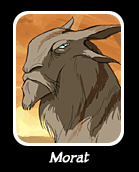 Morat
Morat
Race: Morat
Affiliation: Dependent Ally
Biology: 1.6m tall furred mammaloid bipeds. Separated by less
than a million years from the pre-Soia common ancestor with
their Delrias cousins, the Morat are smaller and sleeker, and
with a more varied diet and a less martial culture. Considered
"degenerate scavengers" by the purely carnivorous Delrias, the
Morat are nonetheless quite dangerous in personal combat.
Homeworld: Kabel
Capital: Morat
History: Not unlike the Delrias, the Morat exhibit a nationalist
pride, born of their ancestral history of pre-Soia galactic
empire, that belies their current status as a client state.
Prior to the war, the Morat had been Umiak trading partners in
the Steppes region, but were independent-minded and had strongly
resisted Umiak pressure for more binding ties. The Morat had
helped facilitate early contact between Loroi and Umiak, but
Morat reaction to the Loroi was suspicious: while very
interested to learn of the existence of their ancient Delrias
kin, the Morat were not pleased to find them under Loroi
occupation. Rapid expansion of both the Loroi and Umiak into the
Steppes hemmed in and squeezed out any ambitions of Morat
expansion. The Morat finally acceded to Umiak influence at the
start of the war when the Loroi forced the issue by using Morat
space for their failed 2136 counterattack.
Notes: The Morat are still nominally a sovereign power, and
Morat fleets continue to fight alongside their Umiak allies when
defending their section of the frontier. However, ever since the
Loroi Semoset offensive brought Loroi lines back into contact
with Morat territory in 2146, Loroi raids have ravaged many of
the Morat border systems, and the ruinous demands of the Umiak
war economy have left the Morat impoverished, depopulated and
demoralized, a hollow shell of their former prosperity. Despite
possession of an independent military, the Morat are now almost
wholly dependent on the Umiak for their survival.
Biology
Yes, it is known for certain that Kabel was the homeworld for the Delrias, Morat and all of the Fenrias domesticated organisms that are spread across parts of the Local Bubble.
Your genes carry much of the history of your species' evolution within them. All organisms on Earth share the same genetic foundations, and you can tell just by looking at their genes how closely two organisms are related and even estimate how long ago they shared a common ancestor. This is done by identifying specific marker DNA sequences and tracking which ones are in which species. And you can clearly see the differences between Earth organisms and those from an alien world, because even if their physical forms are very similar, their genetic foundations will be completely different.
If in our future humans travel to other planets and live there, and bring domestic animals with us, our Earth-based DNA will identify us as being from Earth, even after 200,000 years. The genes of Earth organisms will always be distinct from any local alien life, and it would be pretty easy to tell the colony worlds from our homeworld, since a colony world would have a limited number of Earth species -- maybe several hundred -- while Earth would have millions or billions, and Earth would have a fossil record of the evolution of these species going back 4 billion years, whereas the local record on each colony world would only go back to the founding of the colony. It might take some research to figure this out if the history had been lost, but the evidence would be very clear.
The Delrias and Morat aren't just from the same homeworld, they're very closely related, more closely than humans are related to chimpanzees, more analogous to homo sapiens and Neanderthals. It's pretty obvious just by looking at them that they're related, which would be confirmed by a genetic test.
Kabel was mostly destroyed at some point almost a million years ago (the Fenrias factions frequently warred among each other), and this made it a little bit more difficult to immediately recognize that Kabel was the homeworld, since many of the native species had gone extinct. The Delrias, who were on the planet Rubat when they rediscovered starflight, didn't immediately recognize Kabel as the homeworld when they first colonized it. But after having had enough time to study the local life and the fossil and archaeological record, they found clear evidence that showed that themselves and all their domesticated organisms shared common ancestry with the primitive forms of life still living on Kabel, and that these life forms had evolved on Kabel and were present in the fossil record going back hundreds of millions of years.
The Morat are closely related to the Delrias, having descended from the same Fenrias ancestors. They are not quite as large, are omnivorous, and have a more egalitarian society than the Delrias, and are not quite as belligerent.
In other species, like the Delrias, the females are larger and more aggressive
Maybe it’s the Fenrias (Delrias and Morat) that use a seahorse-style system. This system seems to encourage monogamy, as a more conventional female-gestation system better supports harem type organization. I have said on the union_races page that Delrias pregnancies result in multiple-birth litters.
• Fenrias’ prehistoric ancestors were probably persistence hunters similar to humans, with an efficient bipedal gait that allowed them to run long distances. They were probably thin and wiry, unlike the burly modern Delrias.
Why are [the Delrias] mammaloid and not mammals?
• As far as I'm aware, our current taxonomic system is
completely tied to our own biosphere; even if the Delrias had
identical characteristics to mammals, they can't be classified
as mammals because they are not directly related in any way to
any Earth organism. I'm not sure what (if any) plans that
taxonomists have to classify alien organisms, but I would guess
that they will come up with completely new taxonomic names (many
of which will probably be referential to Earth groups).
• Jericho wrote:
Are the delrias like spotted hyenas or lions dimorphically
speaking? Do they lactate? Or are they born with teeth and are
capable of devouring meat from the start?
• The Delrias (and their Morat cousins) have many
characteristics in common with mammals: they are warm-blooded,
have fur, and give birth to live offspring. They do not lactate;
during the developmental period in which the infant is not yet
able to consume meat, it feeds on blood, either taken from a
prey animal or dispensed directly from an adult (of either
gender, through a specialized aperture). Individuals of both
genders are large, muscular and aggressive, with the females
tending to be slightly larger. In the Delrias, the size of
females is variable, with some becoming particularly large and
aggressive.
• Jericho wrote:
They have a warrior culture. Are there special rules for each
gender or is it the same for both?
• Delrias society is based on a clan system that is dominated by
the females. Males are capable warriors and participate in
social hierarchy, but by tradition males leave their birth clans
upon reaching adulthood (as Delrias females prefer to mate with
younger, unfamiliar males), and so are inevitably of lower rank
within the foreign clans they end up in.
• Subjugated Population: Delrias
The five Delrias star systems are still under Loroi occupation,
and so each is ruled by a Loroi military governor appointed by
the Loroi Emperor. After the Second Mannadi War, in recognition
of the contributions of the Delrias to the war effort, an act of
the Union Assembly granted formal Union citizenship to all
Delrias individuals and authorized locally-determined native
governments, but this was largely a symbolic gesture. Each
Delrias system has its own native government and sends a
delegate to the Union Assembly, but these delegates have no
votes, and the Delrias local governments are legally subordinate
to the Loroi military administration. By tradition, the Loroi
officials keep a low profile and leave most local decisions to
native authorities, but the Loroi reserve the right to take any
action that is deemed necessary, and that includes suppressing
native movements for nationalism or independence. Loroi
intelligence agents routinely "remove" any Delrias leaders who
openly challenge Loroi rule or privately plot against it. As you
might expect, the telepathic Loroi are very effective at this.
• The Delrias are proud, aggressive, and bombastic; prior to the
war, they had a clan-based warrior culture in which physical
conflict between factions and individuals was common. The quick
subjugation of the proud Delrias by the Loroi military shook
this warrior culture to its core, and a bloody and chaotic civil
war followed. However, once the fires were extinguished, the
Delrias continued on almost as if the Loroi war had never
happened. The clan-based culture of conflict continues, though
now through political and business channels instead of overtly
military ones. The Delrias still solve disputes through physical
intimidation and sometimes outright violence. The periodic Loroi
assassinations of Delrias nationalist leaders might generate
more local outrage were it not for the fact that lethal
conflicts between individuals and groups are still legal in most
Delrias jurisdictions.
• I think the Delrias adaptation for high reproductive rates may be multiple births.
Delrias and Morat may both pair-bond.
• Fenrias’ prehistoric ancestors were probably persistence hunters similar to humans, with an efficient bipedal gait that allowed them to run long distances. They were probably thin and wiry, unlike the burly modern Delrias. • The coloration of Morat and Delrias is also probably markedly different. Although coloration is probably somewhat variable even within the species.
Worlds
Haidal Nori (ex Oki)
Captured Delrias world. K star.
Rubat (ex Fieras)
Captured Delrias capital. G star. Probably the most Earthlike.
• The Delrias don’t have a “capital” because they don’t have a collective government. Each system is its own city-state, and is still under Loroi rule. But Rubat was their capital before the war.
At the end of the Dreiman period, there were still Fenrias remnant empires along the southern edge of the local bubble, in what is now Nissek and Barsam territory. The Barsam may have been employed as infantry, clearing out the last Fenrias holdouts. Those empires all went extinct; the proto-Delrias who survived on Rubat may have been the descendants of emigrants or captives. • There were also Fenrias pockets along the edge of the Great Wasteland, including the ancestors of the current Morat.
Kabel
• I wonder if Azimol might have Skaven-like scavengers that are descended from the Fenrias. That would be a little silly, but interesting. Certainly though here will be some strange adapted life that was descended from Kabel organisms. I guess this would be kind of like the Fenrias equivalent of Kikkut and Login.
The Morat and Delrias share the same ancestor, and so the same world of origin and the same genetic code base, and there are a few other organisms from the same homeworld that were spread around the region during their empire.
Kabel (Fenrias): Temperate. Mammaloid creatures which feed enriched blood directly to the infant via a specialized aperture. (See below) These are found throughout the Delrias systems, and in particular on Moro. The mammaloid forms feed (a nutrient-infused) blood directly to the infant via a specialized aperture. Fenrias
Rubat
Capital at the time of the war with the Loroi.
Norde
Gomora citadel
Azimol
Because Azimol is relatively nearby to Morat space, it follows that the ruins are directly related to near Morat ancestors; it was probably either the same Fenrias faction or a closely related one that the Morat are descended from.
is a smallish arid world with ruins of a vast planetwide Fenrias megacity. It has a small axial tilt and 4 moons, 2 of which are fairly large. It is relatively cold, with large polar ice caps, and relatively small seas. The equatorial region is overrun by a massive cold desert, which has buried most of the megacity ruins. There are small seas in rift valleys in the temperate latitudes, around which dark vegetation grows. The rest is a Mars rust color, with some darker colors where there is moisture and exposed rock. The majority of the ruins are very ancient, from before the Soia period. There was probably a small Soia colony here, but it was localized and pretty well wiped out. The flora and any fauna are most Fenrias transplants. There may be some primitive native flora. There may have been some Soia-liron livestock or flora, but they were limited to the colony areas and were mostly exterminated. The Union colony was a joint Loroi-Neridi effort, probably primarily as a research colony, but its strategic location quickly made it a key defense location. The planet being a Fenrias archaeological site will add an extra dimension to the Morat occupation. Such as perhaps why they refused the order to glass it when retreating.
• Azimol was under Morat occupation prior to the Semoset
offensive, and I have the feeling that it fell earlier in the
war than Seren, and there was probably a much larger population
there, as there had been less time to evacuate. It was also
probably less well defended since it was under Neridi
administration.
• Azimol is probably currently under Loroi martial law, by
request of the Neridi government. The Morat were cruel
occupiers, but they resisted the Umiak directives to liquidate
the population when the Hierarchy forces evacuated the system.
But this means that they left more Neridi alive with first-hand
experience of their cruel occupation. I guess the Morat governor
of Azimol was sort of a female Gul Dukat.
• Maybe Azimol Citadel is a Morat-built structure!
• Maybe the Morat’s facilities are unusually luxurious, and so
the Loroi Tazites for Tinza prefers to use the flag facilities
aboard the citadel proper, and leaves her flagship docked to the
station most of the time. Maybe she stays aboard the citadel
even when the flagship undocks for action; it might not be a
major command ship (or it’s an older one).
A division is usually led by a Lashret or Soshret. A Mazeit is a
senior captain who may or may not also be in command of a small
group or squadron. In peacetime nearly every captain of a major
capital ship would be a Mazeit, but in the current war situation
you have groups like SG-51 with four squadrons, only one
commanded by a Mazeit, and three being commanded by Torret one
of whom wasn't even Torrai.
Azimol Citadel is an unusual example, because it's a Morat battle station in a Neridi system under Loroi martial law, which is also a Loroi sector command headquarters.
A major headquarters like Azimol usually has a number of stations; the main citadel and a network of satellite battle stations sometimes referred to as "tower" stations. The main citadel usually contains a squadron commander (Mazeit or Lashret) in charge of the battle stations, a sector commander (Tazites) who also has a sector flagship and fleet of variable size; there may also be one or more additional fleets or groups operating in or around the system (each commanded by a Lashret or Soshret).
In the case of Azimol Citadel, the Lashret in command of the station network is actually aboard one of the tower stations, and the main citadel itself is technically commanded by the Neridi governor of Azimol. However, the Loroi Tinza sector commander (Tazites) has her flagship docked to the citadel and she and her staff mainly use the citadel's facilities.
Moro
could have a biome which is derived from the Fieras diaspora, making it a suitable home for the Delrias as well. The Delrias may have occupied Moro (and the Pipolsid) before the Loroi war.
Moro
Technically now in the Maoren sector, but it was an important
base in the “southern” front of the Mannadi wars.
Moro is a temperate world with large oceans, and is the seat of
the Union Assembly. While the system is in Pipolsid territory
and the colony was first founded by the Pipolsid, the planet
sustains a large Barsam settlement that covers most of the
surface continents (the Pipolsid living mainly in submarine
habitats) and is the most populous Barsam colony outside Justa.
Owing to the presence of the Union Assembly, the idyllic
oceanside capital city of Josetchi is home to a diverse
population of different species from across the Union.
Moro was originally colonized in the distant pre-Soia past by
the Fenrias, who were the ancestors of the modern Delrias. The
rich flora and fauna that proliferate across the planet are
descended from transplanted organisms imported from Kabel, the
Fenrias homeworld. Although these organisms have diversified
greatly in the more than half a million years since the end of
Fenrias habitation, the biome is a more complete example of
Kabel life than can be currently found on Kabel itself, which
was mostly destroyed in the ancient internecine Fenrias wars
that predate the Soia era. The ancient Fenrias colony was
destroyed with the arrival of the Soia, and ironically proto-Barsam
remains from that time period can be found here, evidence that
the Barsam ancestors fought directly against the Fenrias to take
the planet. The discovery of these remains served as an
important point of contact between the Pipolsid and Barsam,
which later resulted in the close partnership which led to the
joint colony and, eventually, the formation of the Union.
Yellow star. The Early History claims that Moro also had a Loroi
colony, and this was the last of a series of new colonizations (Hadar,
Peloin, Laget) before the Mannadi War got into full swing.
This was not long after the first meeting of the Interspecies
Convention happened, so this “colony” could be a sort of
permanent ambassadorial settlement in Josetchi. Maybe the Loroi
put a military starbase in the system to help protect it. This
is convention is when the Loroi first met the Barsam. This would
be an important base in the coming wars. Perhaps the Loroi put
the base around an outer planet in the system, technically
claiming that as their own. Maybe the moon of a gas giant.
Perhaps the citadel there was becoming large and imposing, a
kind of symbolic threat of Loroi dominance looming over the
meetings of the Union Assembly.
Moriet
(orig. Muriat) was not a Delrias world, but instead was the forward Loroi colony which the Delrias attempted to take.
(WORK IN PROGRESS)
Fenrias/Delrias/Morat culture seems like it might go into something like "Flying Tiger" adornments, and maybe we'll see something like this on Morat ships. These designs are still in flux; I think I know what they look like, but I haven't yet drawn a satisfactory representation of it.
the proto-Barsam were involved in war against the Fenrias
Reading the article on precursor empires, I get the feeling that the Dreiman sphere of influence only covered the "Northern" part of the modern day Loroi Union (around the area of the Charred Steppes). Would I be correct in that assumption? Dreiman influence extended well into current Union territory, and as far "south" (anti-spinward) so as to include current Pipolsid and Delrias territory. A variety of different Fenrias offshoots held on to territory in what is now Nissek and Barsam territory, and in pockets coreward and spinward along the edge of the Great Wasteland.
Does that imply that the modern day Morat are remnants of a population that was within Dreiman territory (unlike, say, the Delrias, who can be assumed to be descended from a Fenrias remnant)? Not really, they're each descended from multiple Fenrias offshoots that were isolated in different areas at the periphery of Dreiman territory. It's not entirely clear how the current Morat and Delrias got to be where they are, because the Fenrias pockets were wiped out when the Soia arrived, and the worlds on which the Morat and Delrias survived (Morat and Rubat) were previously inside Dreiman territory.
The technology of the Fenrias civilization developed and changed over long stretches of time, starting at TL9 and advancing possibly as far as TL12 in some places before the Dreiman incursion. By that time the Fenrias had splintered into numerous independent empires, with differing culture, technology and even biology.
Can a hypothetical Morat and Delrias couple still produce
viable offspring despite a less-then-a-million year genetic
separation?
It's possible, but I'm inclined to doubt it. The Fenrias empire
split into separate warring nations during their own era, and
the regional Fenrias bloodlines had begun to diverge long before
the arrival of the Dreiman split the empire in two.
The Delrias and Morat are the descendants of an ancient precursor starfaring race (the Fenrias), who are almost a million years removed from their descendants, and who predate even the Dreiman and Soia eras. The Delrias and Morat are as far removed from their Fenrias ancestors as we are removed from Homo erectus. At least some part of Delrias aggression seems to be a recent development, as it is not shared by their Morat cousins. And yet the Fenrias also fought amongst themselves, using weapons of mass destruction. The Fenrias homeworld of Kabel, which is part of modern Delrias territory, had been obliterated in pre-Soia times by weapons of mass destruction at the hand of other Fenrias factions. The long history of Fenrias internecine warfare is mostly unknown, but certainly involved the extinction of numerous offshoot species and cultures. So ancient was the destruction of Kabel that in the era in which the Delrias fought the Loroi, their capital was Rubat, in a nearby system. Kabel, now a recovering but still marginal world, was not even recognized to be the home system of the Fenrias until after the Loroi-Delrias war.
The Delrias seem more psychotic at a small scale, but less psychotic at a large scale, than their precursor ancestors.
The exception to this are the territories that are still technically under Loroi military occupation, such as some Delrias and Arekka worlds. Loroi authorities can and do take out individuals that they think are causing trouble, and they're not very apologetic about it.
I don't have much detail about these kinds of ceremonies, though I'm sure the various alien cultures will have a wide variety. The rite of passage is, I think, kind of a standard hunter-gatherer ceremony, and is probably most strongly retained in martial cultures... so I think we can expect the Delrias in particular to have some unusual (and probably brutal) coming of age rituals.
The strategic scenario in Outsider is based on an amalgam of several different MOO1 and MOO2 playthroughs, so nearly all the Outsider races fill a "slot" that was represented by one of the racial archetypes from MOO. Some are relatively obvious: humans, telepathic space elves, bug aliens, lizard aliens, aquatic aliens, high-tech brainy aliens. Some may be slightly less obvious: furry cat-like aliens, downy bird-like aliens, mercantile aliens, big brawny aliens, hostile-environment aliens. And then a few are not obvious at all: the Meklar slot was filled by the Mannadi, whose only similarity is that they both start with the letter "M". I think the only MOO2 race without an Outsider counterpart is the Darloks (the spy aliens), who weren't in any of the playthroughs in question. And yes, even the Nibiren are based on the primitive indigenous populations occasionally found on planets (who could only be assigned to farming, and not production or research). MOO2 was an amazing game.
Though they are based on archetypes, I have tried to take the various races in unusual directions, where possible. In many SF milieus, the "furry aliens" are very obvious cat analogues, so I tried to make the Delrias/Morat a little bit different. I toyed with the idea of giving them horns, but decided that an extra pair of ears gave a similar look. And I don't know of any Earth predators with horns; they seem to be an exclusively herbivorous feature.
There were only two major alien conflicts prior to the current war: the war with the Delrias early in the colonization period, and the series of wars against the Mannadi and their allies. I think it could be said that the Mannadi grossly underestimated the Loroi (in a similar manner to which the Japanese grossly underestimated the Americans), but in the Delrias conflict most oddsmakers would have considered the Loroi the underdog.
Bluecrest rebellion: There was some unrest in Delrias territory, as some Delrias businesses had been included in the government takeover (and a few Delrias plutarchs had been punished for price gouging), but this was more or less business as usual.
• At the end of the Dreiman period, there were still Fenrias remnant empires along the southern edge of the local bubble, in what is now Nissek and Barsam territory. The Barsam may have been employed as infantry, clearing out the last Fenrias holdouts. Those empires all went extinct; the proto-Delrias who survived on Rubat may have been the descendants of emigrants or captives. • There were also Fenrias pockets along the edge of the Great Wasteland, including the ancestors of the current Morat.
• I had the idea that the Pipolsid might have uplifted the Neridi, but I think the Pipolsid were mostly subjugated by the Delrias at the time of Loroi contact.
The Delrias and occupied Arekka send delegates to the Assembly; they can debate on the Assembly floor and serve on committees, but their votes have an "asterisk" next to them (in most cases, they don't count). The Arekka are split into two groups, one that is Loroi occupied, and the other which is independent. Only the occupied portion of the Arekka are represented in the Assembly; the independent part are not members of the Union.
The Nissek and Historians and independent Arekka are not members of the Union, and so they are not represented in the Assembly. Each usually has ambassadors on Moro, Deinar, and wherever the Azerein is at.
5/26/21
• Maybe Mozin presses Alex to try to influence the Loroi to sue
for peace. With his status as a successful military commander,
they might listen to him where they do not listen to the Barsam.
• I think maybe when the Golim joined the Union there was some
special deal where either the Golim don’t send delegates or
their votes don’t count, since they would effectively be more
votes for the Loroi, since the Golim would be mesmerized and do
whatever the Loroi wanted.
• Maybe one of the reasons why the Delrias are content to remain
technically occupied is that as an occupied nation, they are
mostly exempt from paying taxes to the Union. Maybe after the
Mannadi wars, the Delrias were offered full member status, and
they declined. In addition to the tax benefits, Delrias society
had never really developed effective mechanisms from handling
their own aggressive tendencies (which is what ultimately doomed
their ancestors).
Delrias are aggressive toward everyone, especially their own kind.
• Most would have some kind of coming-of-age ceremony, especially those with martial cultures. The Delrias are probably notable examples, especially since they are a really old culture.
Once the space war was lost, the Delrias didn't expect to win any large-scale battles, but they considered themselves to be unconquerable; because they are so large and physically dangerous, and of a culture in which nearly every fit adult has fighting skills, they expected to be able to make occupation so costly that the Loroi would give up the attempt and agree to a peace treaty. They were making plans for perpetual to-the-last-man resistance similar in some ways to what the Japanese were planning at the very end of WWII. However, the Loroi special forces were able to effectively decapitate the Delrias command structure and control some key replacements, and so each of the Delrias worlds surrendered promptly after limited fighting. This unexpected reversal (confounding the expectations of the Delrias populace) led to the collapse of the society and a bloody civil war.
Anyway what i wonder is what could possible have motivated the delrias need for physical prowess when clearly brains wins over brawns in evolutionary terms. Were they competing with gigantic predators? (yes i'm well aware that they themselves are gigantic predators). This question also applies to the Niberen which i assume are on similar intellectual capacity as us Humans. I don't agree that brains always win over brawn in evolution; if it did, you'd expect that nearly every type of animal would inevitably become very smart, which hasn't happened. Selection pressures can result in some very strange and non-intuitive outcomes: consider birds like the peacock or bird of paradise, where male physical features that are actually hurtful to survival are encouraged through arbitrary female selection preferences. The Delrias and their ancestors have had high technology for more than a million years, and so are pretty far removed from the processes of "natural" selection based on environmental pressures or predator/prey relationships. Instead, Delrias selection pressures are societal; Delrias social status (and therefore breeding priority) is based on physical intimidation, and so selection is in favor of larger and more aggressive individuals. The related Morat do not have as violent a social structure, and so do not have the same selection pressure for size and strength. But in the case of the Delrias and Morat, intelligence and size/strength are not an either/or proposition; the Morat are not smarter than the Delrias just because they are less strong. Large brains and big muscles each require a lot of nutrition to power, but once you've got high technology, obtaining lots of food is really not a serious problem.
Morat
• The Morat might not have any ships much larger than a heavy cruiser or battlecruiser, reducing the need for heavier weaponry than a heavy blaster. No doubt they use a lot of Umiak torpedoes. • Perhaps collect the Morat, Historian, and Barsam ship classes in a “Third-Party” fleet page.
• Prior to the Semoset offensive, the Morat were probably doing pretty well. They may have occupied some of the former Loroi colonies (such as Azimol), and perhaps produced a series of heavier ships. But they suffered when the Loroi burned the Steppes, and there were no doubt previous raids into Morat territory, likely direct strikes on Terihe and Norde; the infrastructure used to build ships may have been in those systems, and could have been destroyed. Also, their resources may be tied up in Umiak-mandated projects since then. So they may be under sort of “Washington Treaty” restrictions, and so produce mainly crusiers and a few heavier “dreadnoughts” that they can cobble together from the cruiser parts they have.
• Morat might have some more hyena-like coloration.
• Gomora as a citadel, perhaps the Morat citadel at Norde.
Most of the captured Neridi systems were made a part of Morat territory, and so were under a joint Umiak-Morat occupation. The largest captured Neridi colony was Azimol, which had a significant Loroi population. The Neridi were by no means innocent bystanders (a Neridi civilian can commit sabotage as well as anyone else), and it was a messy situation; when a facility blows up, you don't necessarily know who did it. The occupation forces were perplexed by the ability of captured populations to wage an effective insurgency even after they were rounded up and monitored. At one point the Morat began to suspect that the Neridi were also secretly telepathic. And unlike the comparatively dispassionate Umiak, the Morat (who were under a lot of pressure) responded very harshly to the insurgency. To make a long (and unpleasant) story short, when the decision was made that the captured colonies could not efficiently be pacified, the resulting liquidation included Neridi as well as Loroi.
The Neridi have skin in this game. In addition to the losses during invasion and occupation, when the Umiak started raiding Laget through Tithric territory, it was mainly Neridi civilians who were killed. For the Neridi, the war is personal, and not just against the Loroi. In particular, the Neridi have developed a burning hatred for the Morat, who they had previously regarded as friendly neighbors.
• Maybe the Morat vessels could have some kind of deployed
arrays, like the Turanic ion array frigate. They might be
cooling vanes deployed off the engine nacelles.
• Perhaps the Morat use Umiak-style round-nozzled engines, but
which are arranged in Loroi-style nacelles, but with long shared
drive vanes.
• I think we could get away with three basic Morat ship styles:
a single-vane escort, a double-vane heavy cruiser, and a
triple-vane “dreadnought” or battlecruiser, which is sort of a
Frankestein heavy cruiser with a larger central hull and an
additional engine pair. Each nacelle has two round-nozzled
engines in a pair, and there are two nacelle segments to each
vane. The battlecruiser might have supplementary modules on the
nacelles for additional power.
• Might also have a fighter or corvette, and perhaps some kind
of hybrid carrier, or perhaps a defense station (since we’ll be
seeing Morat forces primarily on the defense).
• The forward end of the nacelles could terminate in stubby
inward-pointing prongs, each of which mounting a blaster turret.
The escort could have single turrets (2 per side, for a total of
4), and the heavy cruiser could have twin turrets (for a total
of 8). Or the escort could also have twin turrets but only a
single prong per side.
5/17/20
• Instead of Loroi ancestry, Alex might choose to ask Talon
about the genocide.
• Maybe the Morat vessels might have Italian-like red and white
striped sections fore and aft. Or maybe the stripes are on the
“wings”; but I think paint would reduce the effectiveness of
heat radiation.
• Maybe part of the reason behind the decision to begin the offensive against the Morat is that the Loroi have broken the Morat codes.
• Maybe some of the Loroi colonies in the Steppes spinward of Seren were on systems or even planets on which some of the Umial clients like the Tenuki or Morat already had colonies.
• The Loroi met the Lurs before 2110, but the Lurs refused formal contact. The Loroi had been trading with the Tenuki for some time before formal contact, at which time the Tenuki brought both Lurs and Umiak diplomats to the meeting. Hosted by the Morat.
• Gomora could be a massive Morat citadel at Norde. Perhaps it has shielding that can thwart even the Tempest's wave-looms, and taking it out becomes the job of the carrier div's fighters.
8/6/21
• Maybe someone (Historians or Morat) could have classical
paintings on their hulls like Sheng Lam’s designs. Or maybe
Neridi.
Language
• The Delrias ambassador who eventually comes aboard the
Tempest to negotiate with the Morat will be a fairly important
character. This may be the same ambassador met aboard Cry of the
Wind, for the sake of clarity. She would be female. Maybe named
something like Arlaan.
• I realize that I don’t yet have any Delrias names, or any
Delrias language words other than the few proper names:
Delrias, Morat, Fenrias, Kabel, Rubat, Ghaf, (Ochi), (Hadar),
Haidal Nori, Arlaan Hif, Batena Ghaf
Mrrshan Emperor names from MOO: Jasana, Prrsha, Yalara, Miamar,
Shandra, Mirana, Darquan, Fargul, Marupa, Harrava Ril, Parasha
Vrrn, Yarrala Hrrsh, Torfang, Arrlaan, Rrlenn
Leader names from MOO:CTS: Amem, Aurya, Bata, Dasya, Haidar,
Kirsi, Natesa Nori, Rachana, Tachus, Zahra.
• I kind of like the idea that most Delrias names would have two
parts. I think it makes sense that the Delrias language includes
H, F, M and P. Maybe use F instead of V (Ghaf). (lol… I already
changed it to Ghaf in the World of the Local Bubble doc…) I
don’t know about CH though.
Sound groups:
-al, -el
-af, -if
-ri-
-as
Del-
Ru-, rub-
Mo-, No-
Ba-
Ha-, hai-
Ka-, ki-
A-
Al-, Ar-
-aan, -raan
-at, -bat
-ya?
-si
-pa
Das
Nat
Nor
Ta
Lu-
See also: Hierarchy Races, Union Races, Precursor Empires,